
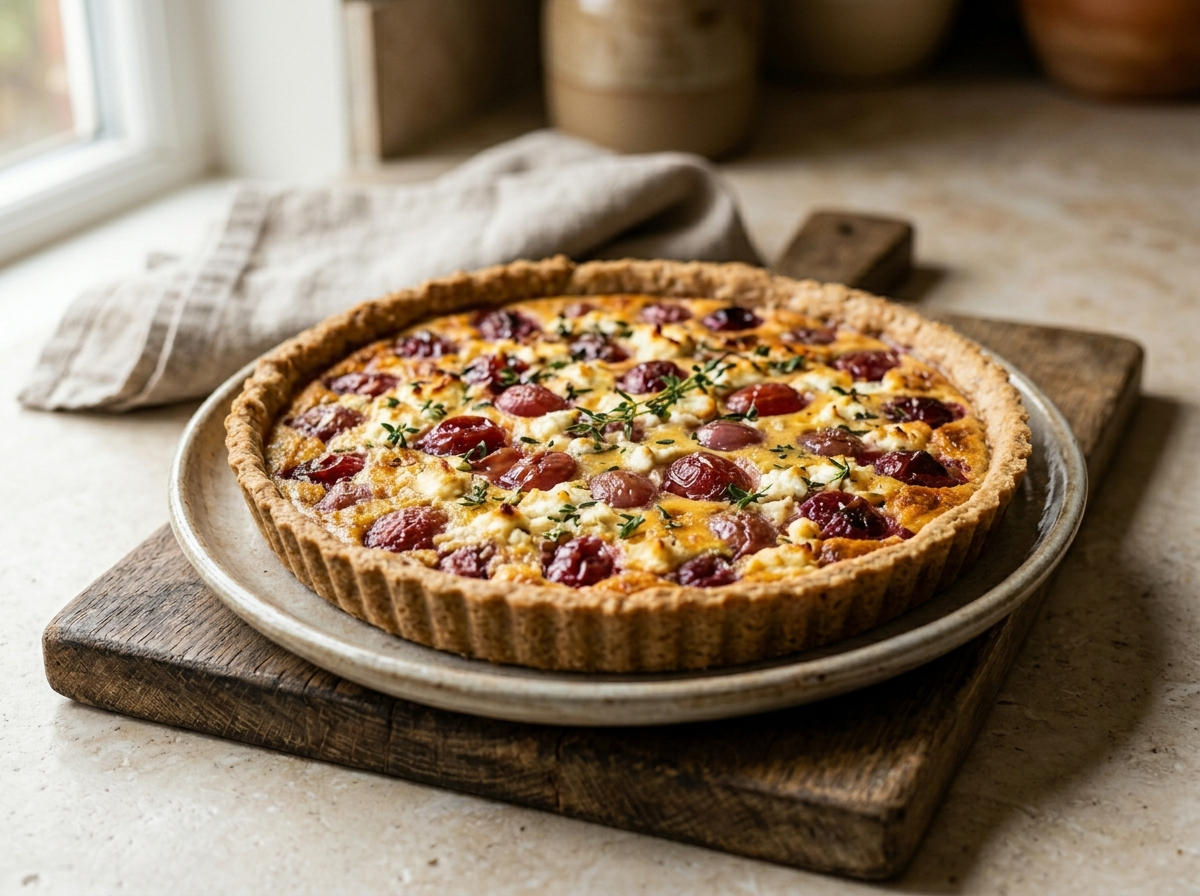
Roasted grapes do something unexpected in a hot oven. They collapse into small pockets of concentrated sweetness, and that contrast with salty, creamy goat cheese is what makes this tart worth baking.
The crust is made with spelt flour, which has a mild nuttiness that plain white pastry lacks. It holds its shape well and doesn’t turn soggy, even after the filling is added.
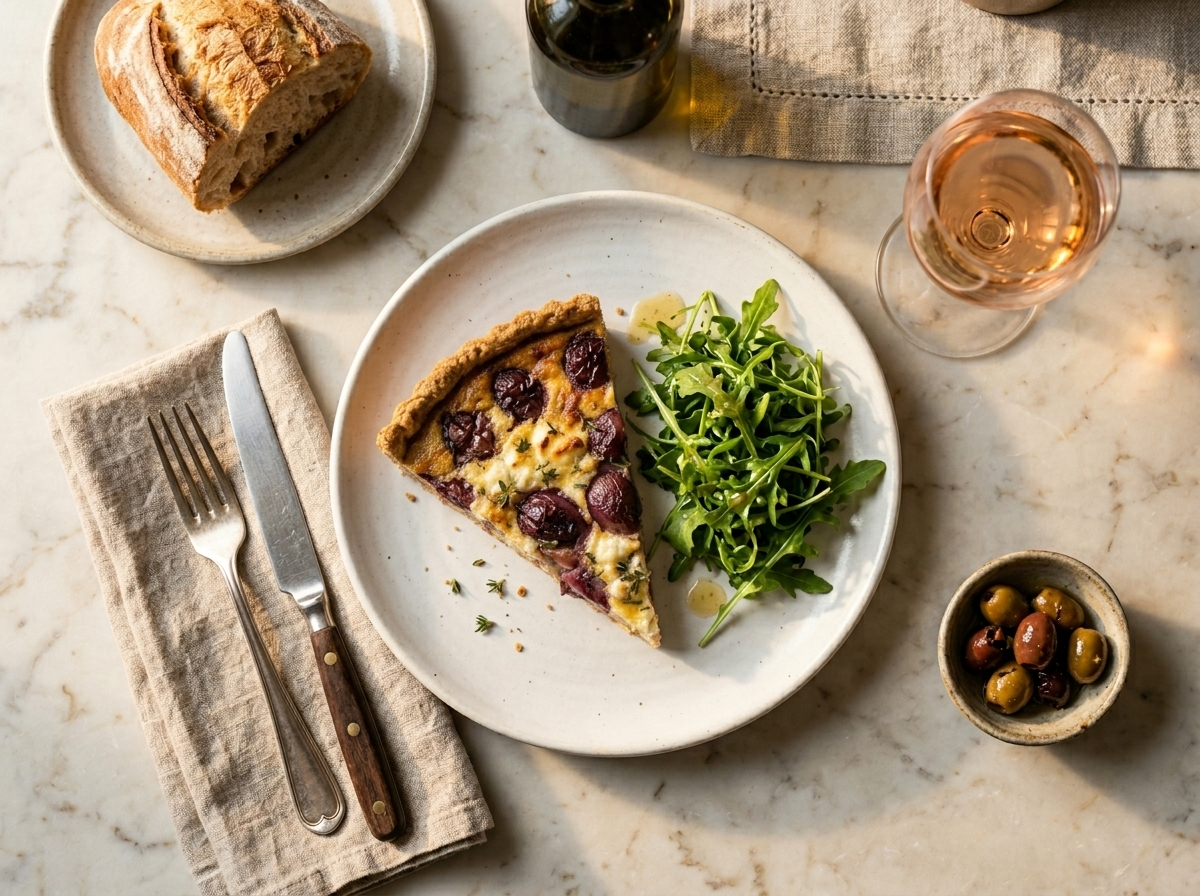
This tart works as a lunch with a green salad, or as a starter sliced into thin wedges. You can blind bake the shell a day ahead and assemble it the morning you plan to serve it.
The ingredient list stays short. The grapes roast in about 20 minutes while the shell bakes, so both components come together at roughly the same time.
Why You’ll Love This Recipe
- Spelt crust stays crisp and holds its shape cleanly
- Roasted grapes add concentrated sweetness with no extra sugar
- Shell can be blind baked one day ahead
- Simple enough for a weeknight, presentable enough for guests
Ingredient Notes
- Spelt flour: White spelt flour gives a lighter, more crumbly crust. Wholegrain spelt works too but produces a denser, earthier shell – both taste good. Plain all-purpose flour can substitute, but you’ll lose the nutty depth.
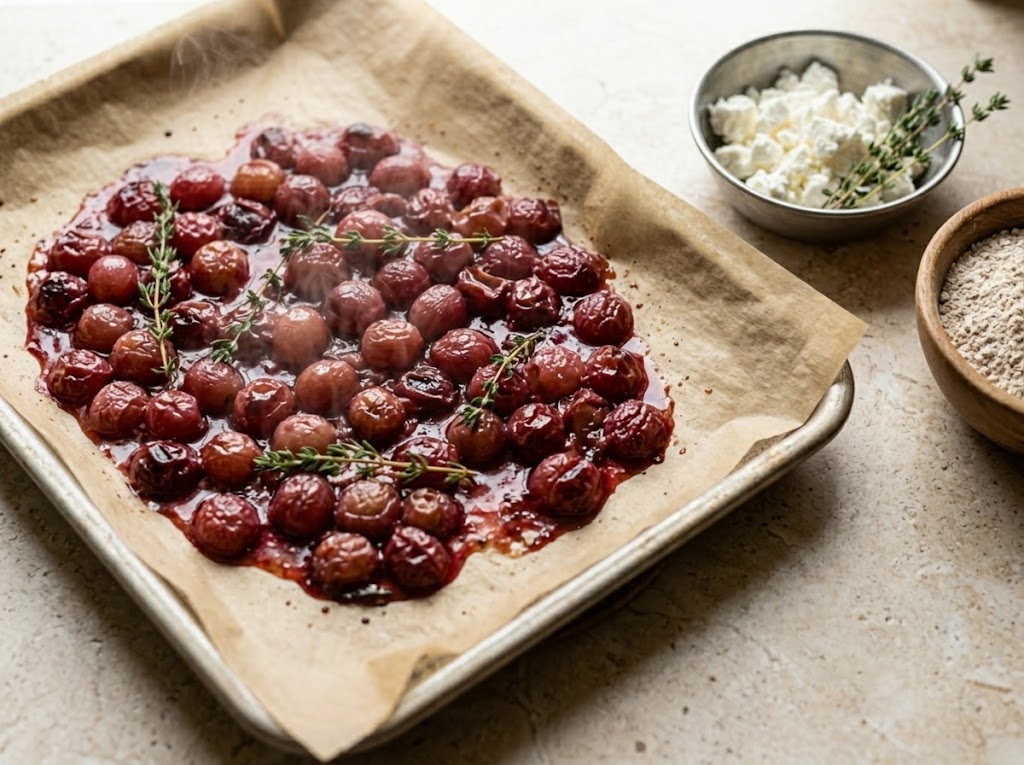
- Red grapes: Seedless red grapes roast evenly and hold their shape better than green ones. Black grapes work and add a deeper colour to the finished tart.
- Goat cheese (soft): Use a soft, fresh chèvre that crumbles and spreads easily. A firmer aged goat cheese won’t melt into the filling the same way. Cream cheese blended with a little lemon juice is a reasonable swap if needed.
- Eggs: Two whole eggs plus one yolk keep the custard base rich but not heavy. The yolk adds colour and helps the filling set with a slight creaminess.
- Double cream: Double cream (heavy cream) gives a stable, sliceable set. Single cream can be used but the filling will be slightly softer.
- Fresh thyme: Fresh thyme alongside the grapes while roasting adds a quiet herby note that cuts through the richness of the cheese. Dried thyme works at half the quantity.
Spelt Roasted Grape and Goat Cheese Tart
Description
The spelt shortcrust stays crisp and nutty, holding a balance of sweet roasted grapes and sharp goat cheese that sets cleanly when baked.
Ingredients
Spelt Pastry
Roasted Grapes
Goat Cheese Filling
Instructions
Make the spelt pastry
- Combine 200 g white spelt flour and 1/4 tsp fine sea salt in a large mixing bowl.
- Add 100 g cold cubed butter and rub it into the flour with your fingertips until the mixture resembles coarse breadcrumbs with a few larger pieces still visible.
- Add 1 egg yolk and 2 tbsp cold water. Mix with a fork, then use your hands to press the dough together, adding the extra tablespoon of water only if it won't come together.
- Shape the dough into a flat disc, wrap in parchment or cling film, and refrigerate for 30 minutes.
Roast the grapes
- Heat the oven to 200 C / 390 F. Line a rimmed sheet pan with parchment.
- Spread 300 g halved grapes on the prepared pan. Drizzle with 1 tbsp olive oil, scatter over 4 thyme sprigs, and season with salt and pepper.
- Roast for 18-20 minutes until the grapes are collapsed and lightly caramelised at the edges. Set aside to cool completely.
Blind bake the spelt shell
- Remove the dough from the fridge. On a lightly floured surface, roll it to about 3 mm thickness and line a 9-inch loose-bottomed tart tin, pressing the dough gently into the edges.
- Trim the excess dough flush with the rim. Prick the base all over with a fork. Refrigerate the lined tin for 10 minutes.
- Line the chilled shell with parchment and fill with baking weights or dried beans. Blind bake at 200 C / 390 F for 15 minutes until the edges are firm and pale gold.
- Remove the weights and parchment. Return the shell to the oven for 5 more minutes until the base looks dry and just starting to colour. Remove and reduce the oven temperature to 170 C / 340 F.
Make the filling and bake
- Whisk together 2 whole eggs, 1 egg yolk, 150 ml double cream, 1/4 tsp salt, and 1/4 tsp black pepper in a bowl until smooth.
- Crumble 180 g goat cheese evenly over the base of the warm blind-baked shell.
- Arrange the cooled roasted grapes over the goat cheese in a single layer.
- Pour the egg and cream mixture slowly over the filling, letting it settle around the grapes.
- Scatter 1 tsp fresh thyme leaves over the top. Bake at 170 C / 340 F for 28-32 minutes until the edges are set and the centre has a faint wobble.
- Remove from the oven and rest the tart in the tin for 15 minutes before releasing and slicing.
Nutrition Facts
Servings 6
- Amount Per Serving
- Calories 390kcal
- % Daily Value *
- Total Fat 26g40%
- Saturated Fat 14g70%
- Cholesterol 155mg52%
- Sodium 380mg16%
- Potassium 210mg6%
- Total Carbohydrate 32g11%
- Dietary Fiber 3g12%
- Sugars 9g
- Protein 12g24%
- Vitamin A 750 IU
- Vitamin C 4 mg
- Calcium 120 mg
- Iron 2 mg
- Vitamin D 35 IU
- Vitamin E 1.5 mg
- Vitamin K 8 mcg
- Thiamin 0.2 mg
- Riboflavin 0.3 mg
- Niacin 2 mg
- Vitamin B6 0.2 mg
- Folate 35 mcg
- Vitamin B12 0.6 mcg
- Phosphorus 195 mg
- Magnesium 28 mg
- Zinc 1.2 mg
* Percent Daily Values are based on a 2,000 calorie diet. Your daily value may be higher or lower depending on your calorie needs.
Note
Additional Notes
- Chill spelt dough for at least 30 minutes before rolling for a clean, non-shrinking shell.
- Roast grapes at 200 C until just collapsed, about 18-20 minutes, not longer.
- Cool roasted grapes fully before adding to the custard to prevent premature cooking.
- Bake the filled tart at 170 C, not higher, to avoid a cracked or puffed surface.
- Rest the finished tart 15 minutes before slicing so the filling holds its shape cleanly.