
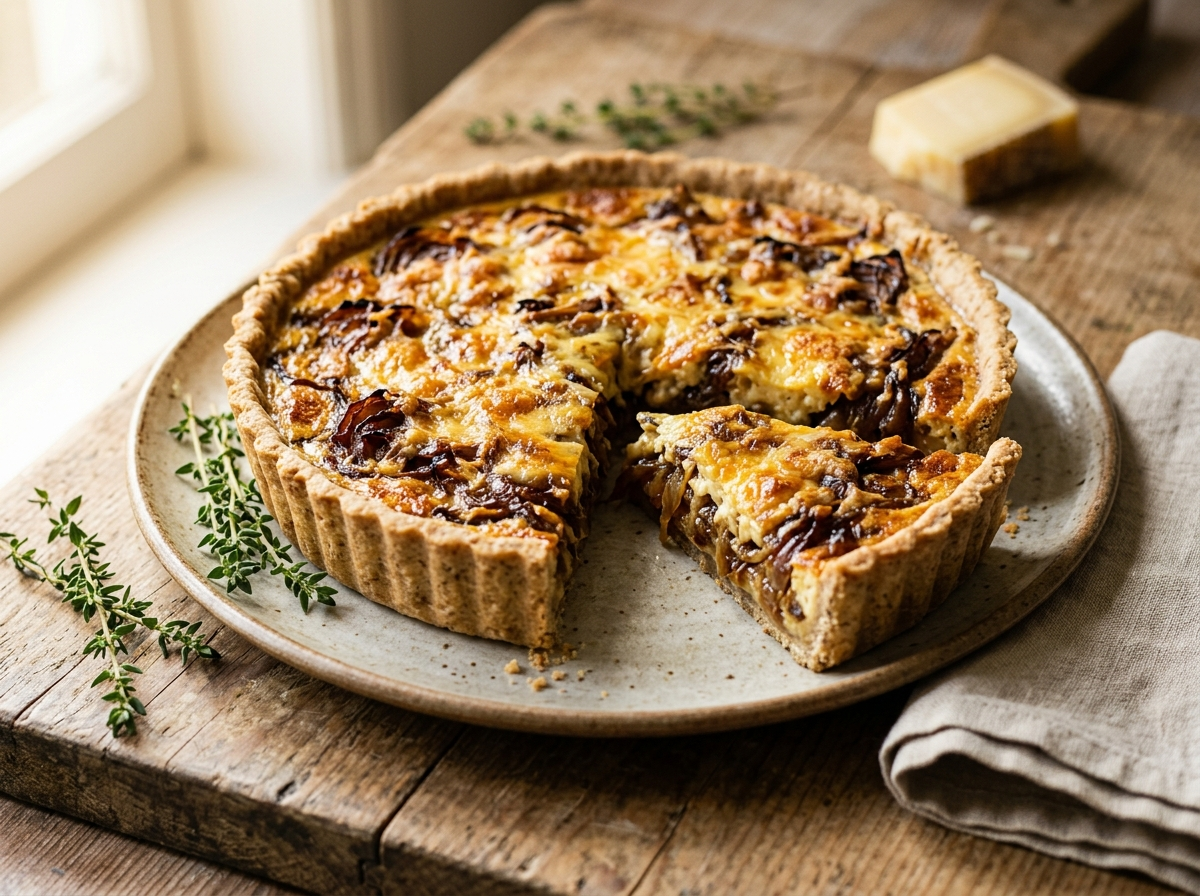
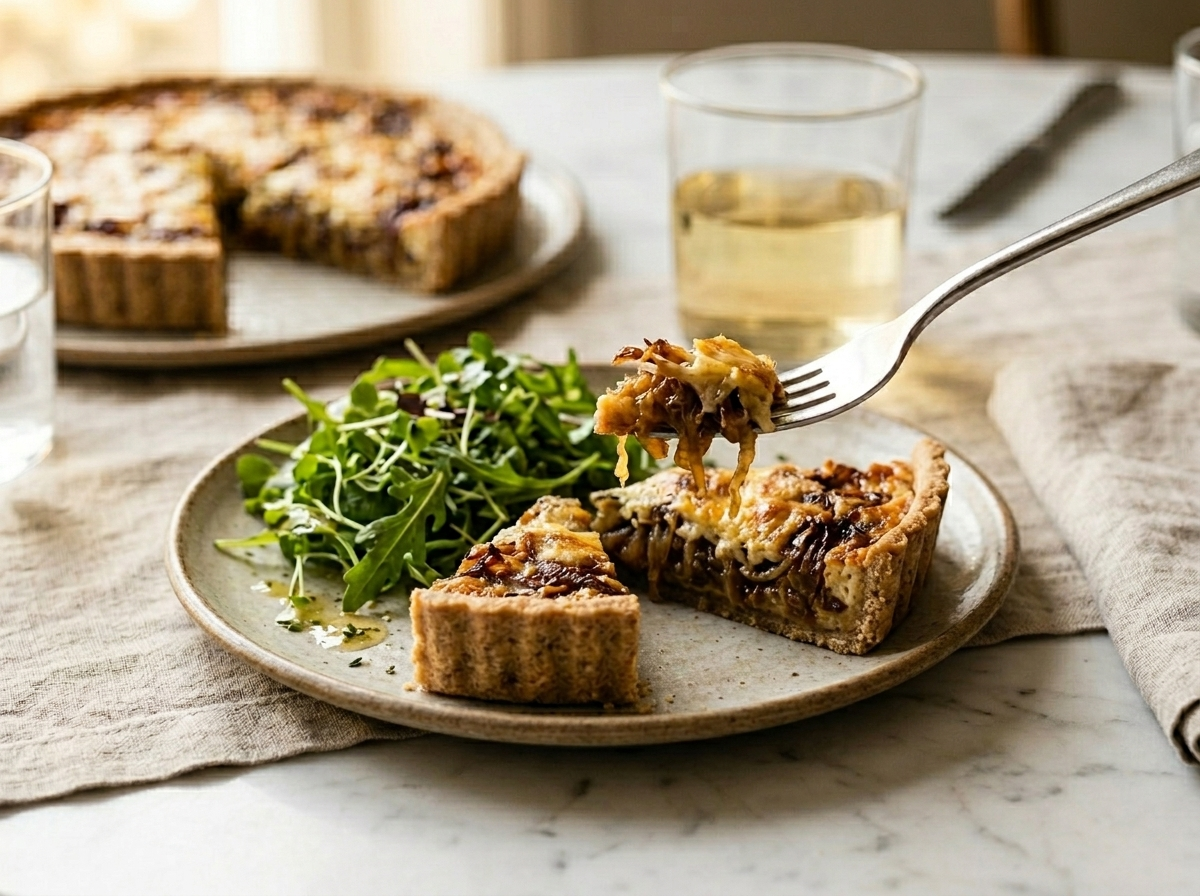
This tart starts with a spelt shortcrust that bakes up firm and slightly nutty, without the cardboard texture you sometimes get from whole grain pastry.
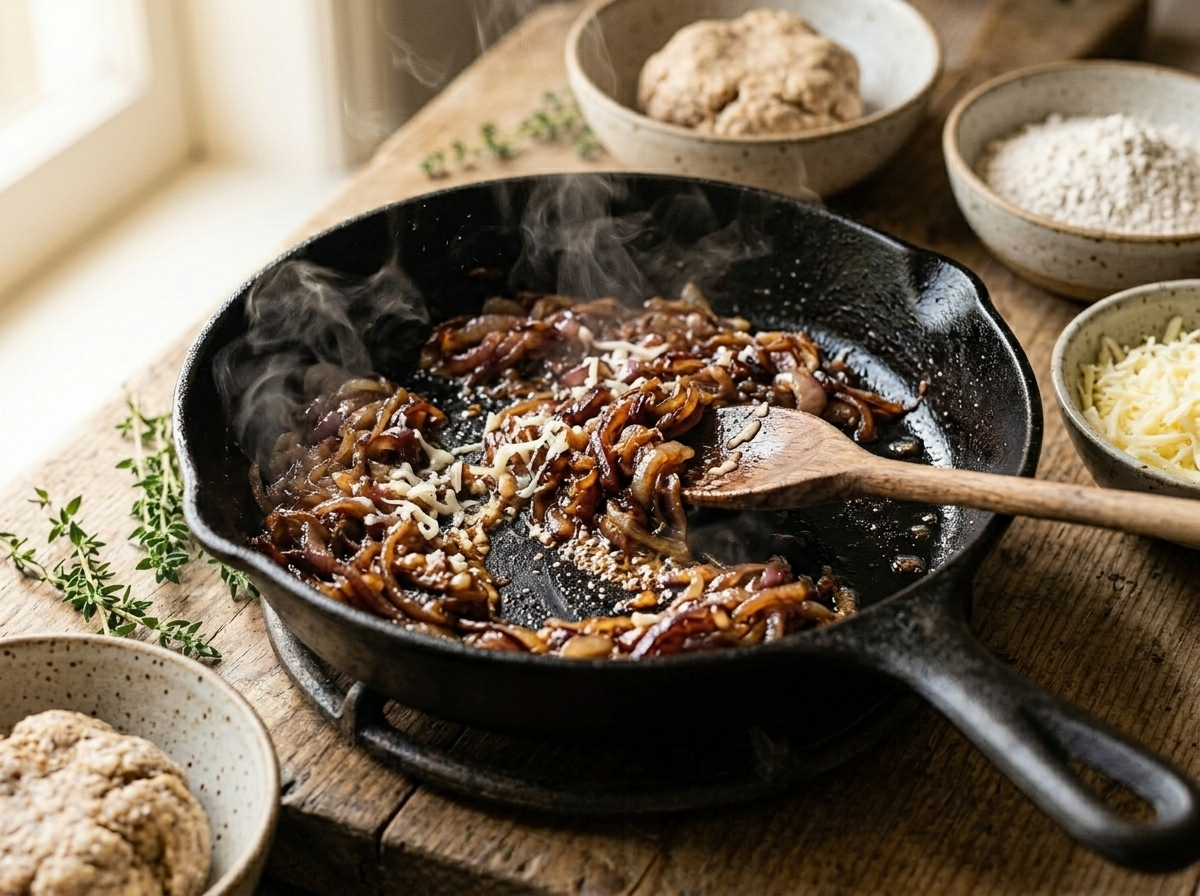
The filling is caramelised onions, eggs, cream, and grated Gruyère. Nothing complicated. The onions need time on low heat – around 25 minutes – so they turn golden and sweet rather than soft and pale.
Spelt flour has less gluten than wheat, which means the pastry is more fragile to handle but short and crisp once baked. Worth the extra care when rolling.
You can blind-bake the shell, make the filling, and refrigerate both separately. Assembly takes about five minutes before it goes into the oven.
Why You’ll Love This Recipe
- Spelt crust stays crisp under the wet filling
- Caramelised onions add depth without extra ingredients
- Components prep ahead and assemble in minutes
- Gruyère melts into a firm, clean-tasting custard
Ingredient Notes
- spelt flour: Use white spelt for a lighter crust or wholegrain spelt for more depth and a darker colour. Both work, but wholegrain absorbs more butter so the dough can feel drier – add cold water a teaspoon at a time.
- unsalted butter: Keep it cold and cut into small cubes before rubbing into the flour. Cold butter creates a flakier, shorter texture once baked.
- Gruyère: Gruyère melts smoothly and has a mild nuttiness that pairs well with sweet onions. Comté or Emmental are close substitutes. Avoid pre-grated cheese – it contains anti-caking agents that affect the texture of the custard.
- yellow onions: Yellow onions caramelise well and develop natural sweetness on low heat. White onions work but can turn slightly sharp. Avoid red onions – the colour bleeds into the custard.
- double cream: Double cream gives the custard a firm, sliceable set. Single cream or half-and-half produces a softer, slightly looser result that can weep liquid when sliced.
- eggs: Use two whole eggs plus one yolk for a richer, more stable custard. The yolk adds fat and helps the filling hold its shape when sliced cold.
Spelt Onion and Gruyère Tart
Description
Spelt shortcrust holds its shape without going tough, and that firm base is what makes this tart work - the slow-cooked onions stay soft and the Gruyère sets into a clean, savoury custard.
Ingredients
Spelt Shortcrust Pastry
Caramelised Onion Filling
Gruyère Custard
Instructions
Make the Spelt Pastry
- Combine the spelt flour and salt in a large mixing bowl. Add the cold butter cubes and rub them into the flour with your fingertips until the mixture looks like coarse breadcrumbs.
- Add the egg yolk and 2 tablespoons of cold water. Mix with a fork until the dough just comes together - add the third tablespoon of water only if the dough feels dry and crumbly.
- Shape the dough into a flat disc, wrap it in baking paper, and refrigerate for 30 minutes.
Caramelise the Onions
- Melt the butter with the olive oil in a large heavy-bottomed skillet over the lowest heat setting. Add the sliced onions and salt, then stir to coat.
- Cook uncovered, stirring every 5 minutes, for 25 to 30 minutes until the onions are completely collapsed and deep golden brown. Add the thyme and black pepper, stir once more, and remove from the heat. Set aside to cool.
Blind-Bake the Pastry Shell
- Heat the oven to 190 C / 375 F. Lightly flour a clean surface and roll the chilled pastry into a circle about 3 mm thick, large enough to line a 9-inch loose-bottomed tart tin.
- Carefully lift the pastry over the tin and press it into the base and sides without stretching. Trim the overhang with a sharp knife. Prick the base with a fork.
- Line the pastry with baking paper and fill with baking beans. Blind-bake for 15 minutes, then remove the paper and beans and bake for a further 5 minutes until the base looks dry and just starting to colour. Remove from the oven.
Make the Custard and Assemble
- Whisk the 2 whole eggs, 1 egg yolk, double cream, salt, and nutmeg together in a bowl until smooth.
- Spread the cooled caramelised onions evenly over the blind-baked pastry base. Scatter the grated Gruyère over the onions.
- Place the tart tin on the oven rack, then carefully pour the custard over the onions and cheese until the filling comes just below the pastry rim.
Bake and Rest
- Bake at 190 C / 375 F for 25 to 30 minutes until the custard is golden on top and has a slight wobble only in the very centre when the tin is gently shaken.
- Remove from the oven and place on a wire rack. Rest the tart for at least 15 minutes before removing from the tin and slicing.
Nutrition Facts
Servings 6
- Amount Per Serving
- Calories 420kcal
- % Daily Value *
- Total Fat 27g42%
- Saturated Fat 15g75%
- Cholesterol 155mg52%
- Sodium 420mg18%
- Potassium 260mg8%
- Total Carbohydrate 32g11%
- Dietary Fiber 3g12%
- Sugars 6g
- Protein 14g29%
- Vitamin A 750 IU
- Vitamin C 5 mg
- Calcium 280 mg
- Iron 2 mg
- Vitamin D 40 IU
- Vitamin E 1.5 mg
- Vitamin K 8 mcg
- Thiamin 0.2 mg
- Riboflavin 0.3 mg
- Niacin 2 mg
- Vitamin B6 0.2 mg
- Folate 35 mcg
- Vitamin B12 0.6 mcg
- Phosphorus 220 mg
- Magnesium 30 mg
- Zinc 2 mg
* Percent Daily Values are based on a 2,000 calorie diet. Your daily value may be higher or lower depending on your calorie needs.
Note
Additional Notes
- Rest the pastry dough in the fridge for at least 30 minutes before rolling.
- Cook onions on low heat for a full 25 minutes - pale onions make a flat-tasting filling.
- Blind-bake the spelt shell before adding custard to keep the base crisp.
- Grate Gruyère fresh from the block for the smoothest melt in the custard.
- Cool the tart for 15 minutes before slicing to get clean, firm portions.