
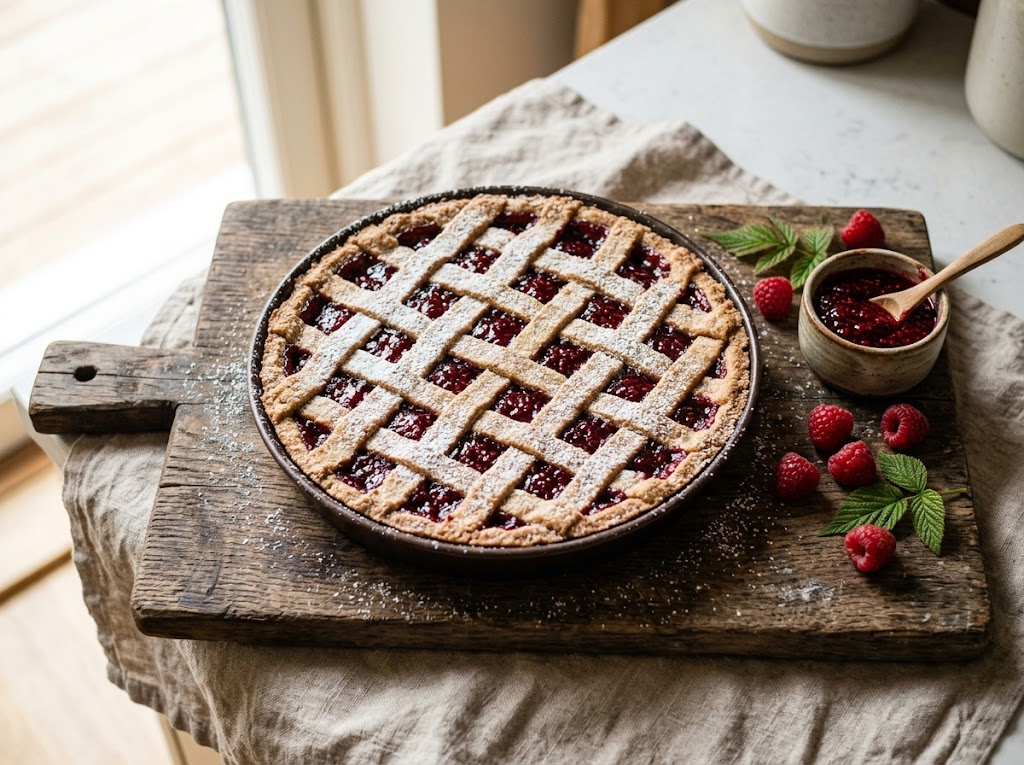
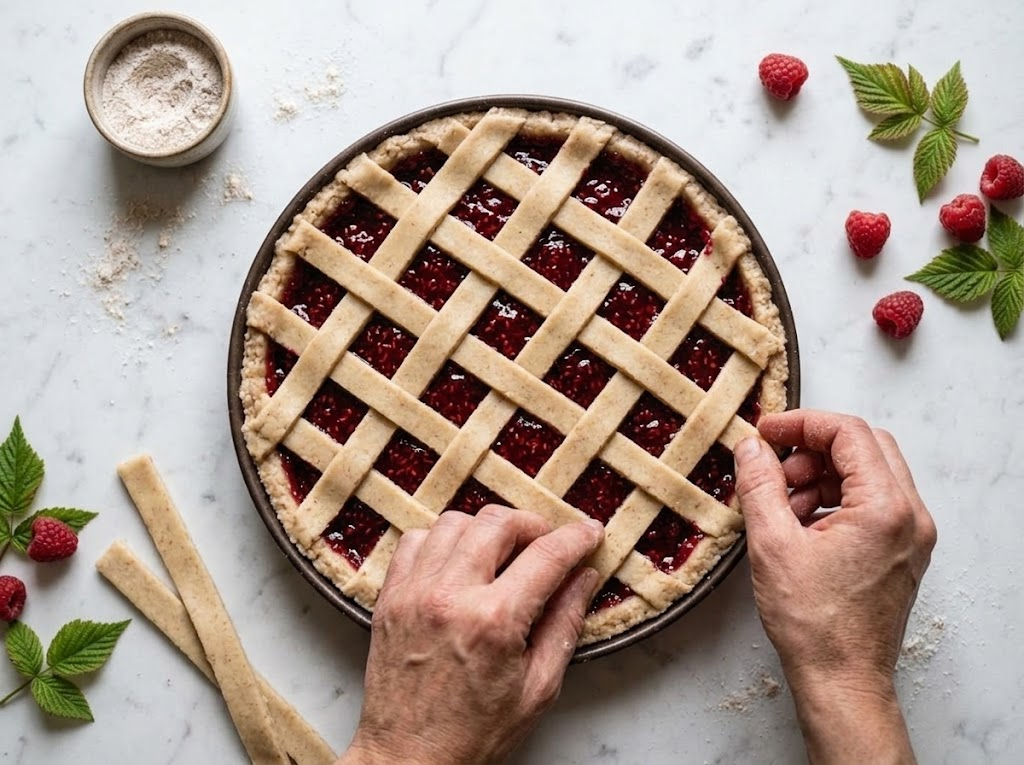
A Linzer tart is one of the oldest European pastries on record, and the structure is straightforward: a spiced nut-and-flour dough, a fruit jam layer, and a woven or cut-out lattice on top.
Using spelt flour here changes the texture in a useful way. The crust is shorter and more crumbly than one made with all-purpose flour, and it has a mild nuttiness that works well with ground almonds and cinnamon.
Raspberry jam is the traditional filling and still the best choice. Its sharpness keeps the tart from feeling heavy.
The dough needs at least an hour in the fridge before you roll it. That rest firms it up and makes the lattice strips much easier to handle.
Why You’ll Love This Recipe
- Spelt and almond dough stays crisp, not soggy.
- One rest in the fridge, no blind baking needed.
- Sharp raspberry jam balances the rich, nutty crust.
- Keeps four days at room temperature, slices cleanly.
Ingredient Notes
- White spelt flour: White spelt gives a lighter crumb than wholegrain spelt while keeping the nutty flavour. Wholegrain spelt works too but makes the dough slightly drier – add a teaspoon of cold water if needed.
- Ground almonds: Ground almonds add fat and a short texture to the pastry. You can swap half the quantity for ground hazelnuts for a more traditional Austrian-style base.
- Unsalted butter: Use cold butter cut into cubes so the fat stays solid until it hits the oven. This is what gives the crust its crumbly, short texture.
- Raspberry jam: A good-quality seedless or seeded jam both work. I prefer seeded for texture, but if you want cleaner slices, seedless is easier. You need a jam with enough pectin to hold its shape when baked.
- Cinnamon and lemon zest: Both are classic in a Linzer dough. The lemon zest lifts the spice without overpowering it – don’t skip it.
- Egg yolks: Yolks enrich the dough and help it hold together without toughening. One whole egg can replace two yolks in a pinch, but the crust will be slightly less tender.
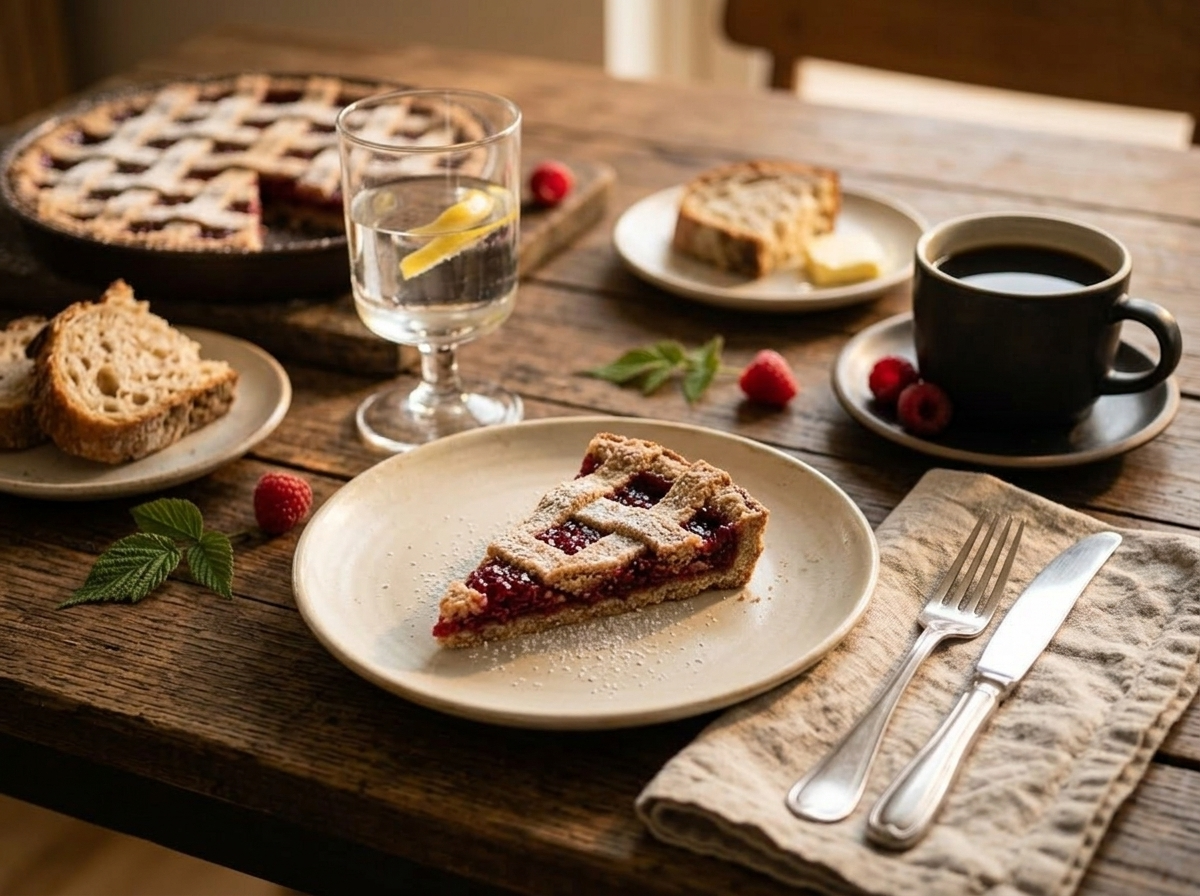
Spelt Raspberry Linzer Tart
Description
Spelt flour gives the shortcrust a slightly earthy, almost almond-like depth that plain flour can't match. The raspberry jam cuts through the richness and keeps every slice balanced.
Ingredients
Spelt Linzer Dough
Filling and Finish
Instructions
Make the Dough
- Combine the spelt flour, ground almonds, powdered sugar, cinnamon, cloves, lemon zest, and salt in a food processor. Pulse briefly to mix.
- Add the cold butter cubes and pulse until the mixture looks like coarse breadcrumbs with no large butter pieces visible.
- Add the egg yolks and pulse just until the dough begins to clump together. Do not over-process - it should hold when pressed but still look slightly shaggy.
- Turn the dough out onto a lightly floured surface. Press it into a flat disc, wrap in cling film, and refrigerate for at least 1 hour or overnight.
Prepare the Tart Shell and Lattice
- Heat the oven to 175 C / 350 F. Lightly butter a 23 cm fluted tart tin with a removable base.
- Remove the dough from the fridge. Cut off roughly one third and set aside for the lattice. Keep it cold.
- Roll the larger portion of dough between two sheets of baking paper to a circle about 3 mm thick and 28 cm wide.
- Carefully lift the dough into the tart tin. Press it gently into the base and sides, trimming any overhang flush with the tin edge. If cracks appear, simply press them closed with your fingertip.
- Roll the reserved dough portion into a rectangle about 3 mm thick. Cut into strips approximately 1.5 cm wide using a pastry wheel or sharp knife. Place the strips on a baking-paper-lined tray and freeze for 10 minutes.
Fill and Assemble
- Spread the raspberry jam evenly over the tart base, leaving a 1 cm border around the edge. The jam layer should be about 5 to 6 mm deep.
- Lay half the chilled lattice strips across the jam at even intervals, pressing the ends lightly into the pastry border. Rotate the tin 45 degrees and lay the remaining strips across at an angle to form a lattice pattern.
- Trim any overhanging ends and press them firmly into the pastry rim to seal.
Bake and Finish
- Bake the tart on the middle oven rack for 38 to 42 minutes, until the lattice is a deep golden brown and the jam is bubbling at the edges. If the rim darkens too quickly, lay a strip of foil loosely around it.
- Remove from the oven and leave the tart to cool completely in the tin on a wire rack - at least 1 hour. The jam sets firmer as it cools.
- Once fully cool, remove the tin ring. Dust the tart lightly with powdered sugar and serve at room temperature.
Nutrition Facts
Servings 10
- Amount Per Serving
- Calories 320kcal
- % Daily Value *
- Total Fat 18g28%
- Saturated Fat 8g40%
- Cholesterol 65mg22%
- Sodium 65mg3%
- Potassium 120mg4%
- Total Carbohydrate 35g12%
- Dietary Fiber 3g12%
- Sugars 18g
- Protein 6g12%
- Vitamin A 380 IU
- Vitamin C 2 mg
- Calcium 45 mg
- Iron 2 mg
- Vitamin D 18 IU
- Vitamin E 3 mg
- Vitamin K 3 mcg
- Thiamin 0.2 mg
- Riboflavin 0.1 mg
- Niacin 1.5 mg
- Vitamin B6 0.1 mg
- Folate 20 mcg
- Vitamin B12 0.1 mcg
- Phosphorus 110 mg
- Magnesium 30 mg
- Zinc 1.0 mg
* Percent Daily Values are based on a 2,000 calorie diet. Your daily value may be higher or lower depending on your calorie needs.
Note
Additional Notes
- Rest the dough in the fridge for at least 1 hour - overnight gives the cleanest lattice.
- Do not stretch the lattice strips when laying them; they shrink back in the oven.
- Use jam with a firm set - runny jam will bubble out and make slicing messy.
- Cool the tart completely in the tin before removing to avoid cracking the base.
- Powdered sugar applied before cooling will absorb into the surface and disappear.