
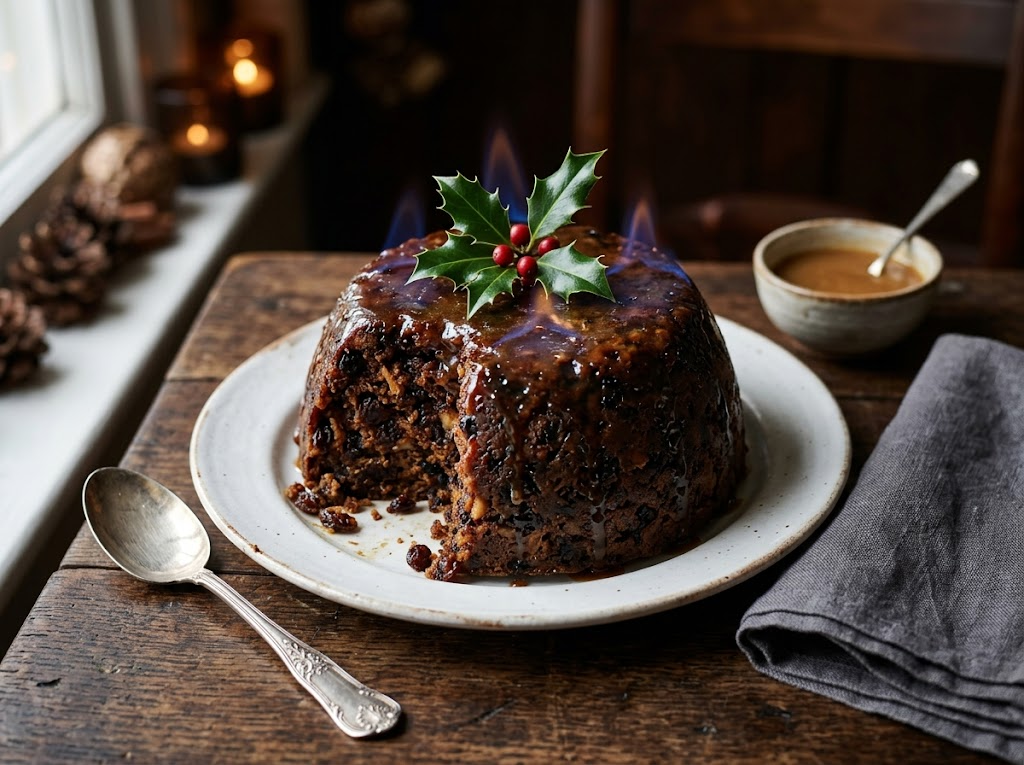
Spelt Christmas pudding follows the same method as a traditional steamed pudding, but the flour swap makes a noticeable difference. Wholegrain spelt adds a mild, nutty quality that pairs well with the dark dried fruit and spiced ale.
The pudding needs a long steam – six hours on the first cook – but most of that time is hands-off. You can make it weeks ahead, which is exactly how it should be done.
On Christmas Day, a two-hour reheat brings it back to the right texture. The flavours stay balanced and the sponge stays moist from the dried fruit and suet.

This recipe uses light spelt flour, which gives a slightly lighter result than whole spelt. If you prefer a denser, more wholesome texture, whole spelt flour works equally well.
Why You’ll Love This Recipe
- Spelt flour adds a nutty depth plain flour can’t match
- Stays moist for weeks when stored correctly
- Make-ahead recipe that improves with time
- Reheats in two hours with no fuss on the day
Ingredient Notes
- Light spelt flour: Light spelt gives a softer crumb. Whole spelt flour works too but produces a denser, more textured pudding. Do not substitute standard plain flour if you want the nutty quality.
- Vegetable suet: Vegetable suet keeps this recipe suitable for vegetarians. Beef suet is the traditional choice and gives a slightly richer result if you’re not cooking for vegetarians.
- Dark ale or stout: Dark ale or Guinness adds bitterness that balances the sweetness of the dried fruit. You can use strong black tea or apple juice as a non-alcoholic substitute.
- Mixed dried fruit: Use a pre-mixed bag or combine raisins, currants, and sultanas yourself. Soaking overnight in brandy or orange juice plumps the fruit significantly.
- Muscovado sugar: Dark muscovado gives deep molasses flavour. Light brown sugar works but produces a milder, less complex pudding.
- Brandy: Used for soaking the fruit and for feeding the pudding during storage. Rum or whisky are both reasonable alternatives.
- Mixed spice: A standard British mixed spice blend of cinnamon, nutmeg, allspice, and cloves. You can blend your own at 2 parts cinnamon to 1 part each of the others.
- Free-range eggs: Two large eggs bind the mixture. There is no reliable egg-free substitute here that maintains the correct texture during a long steam.
Spelt Christmas Pudding
Description
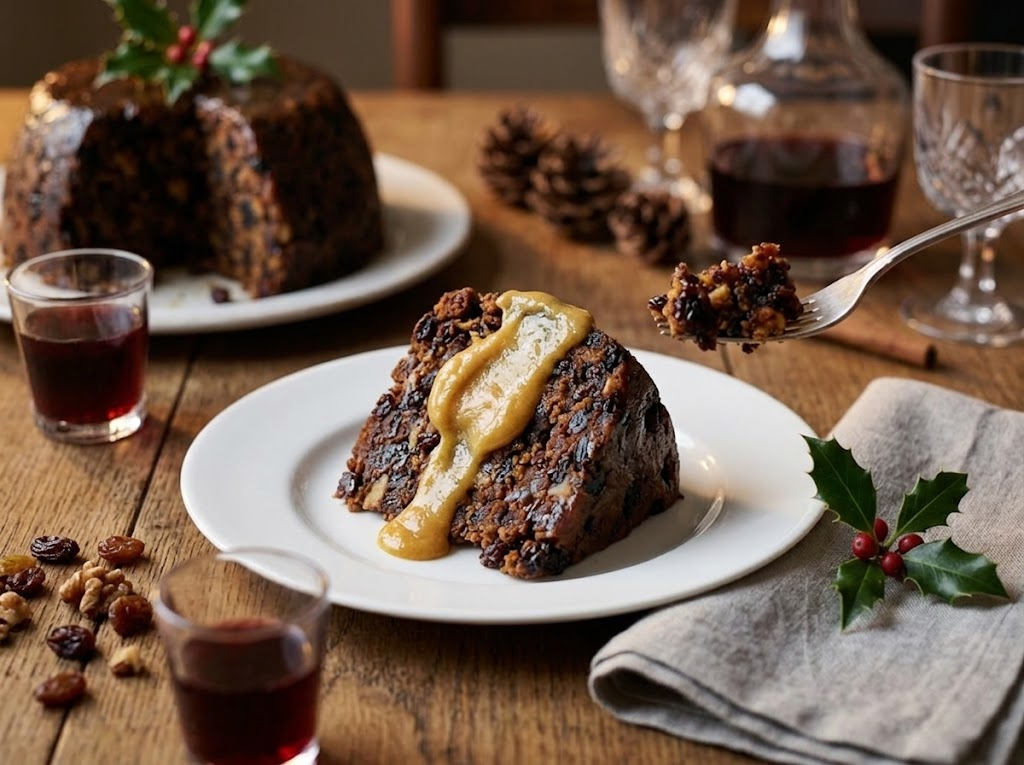
Spelt flour replaces plain flour here, giving the pudding a nuttier crumb and slightly denser texture that holds the fruit and suet together without weighing it down.
Ingredients
Fruit soak
Pudding batter
Instructions
Soak the fruit
- Combine the mixed dried fruit, brandy, orange juice, and orange zest in a large bowl. Stir well, cover with a clean cloth, and leave to soak for at least 12 hours or overnight.
- After soaking, the fruit should look plump and most of the liquid should be absorbed. If any liquid remains, that's fine - it will go into the batter.
Prepare the basin
- Grease a 1.2-litre pudding basin thoroughly with softened butter. Cut a small circle of baking parchment to fit the base and press it in.
- Cut a large square of baking parchment and a large square of foil. Lay them on top of each other and fold a 2 cm pleat down the centre. Set aside.
Mix the pudding
- Sift the spelt flour, mixed spice, cinnamon, and salt into a large mixing bowl.
- Add the vegetable suet, muscovado sugar, and spelt breadcrumbs. Stir until evenly combined.
- Add the soaked fruit and any remaining liquid. Stir well to distribute the fruit throughout the dry mixture.
- Add the beaten eggs, dark ale, and black treacle. Mix until you have a thick batter that drops slowly from the spoon. If it feels stiff, add an extra tablespoon of ale.
Fill and cover the basin
- Spoon the batter into the prepared pudding basin and press it down gently. The batter should come to within 2 cm of the rim.
- Lay the pleated parchment-foil cover over the top, parchment side down. Secure tightly under the rim with kitchen string. Trim any excess overhang to about 4 cm.
- Make a handle by looping string across the top of the basin and tying it firmly. This makes lifting the hot basin out of the steamer easier.
Steam the pudding
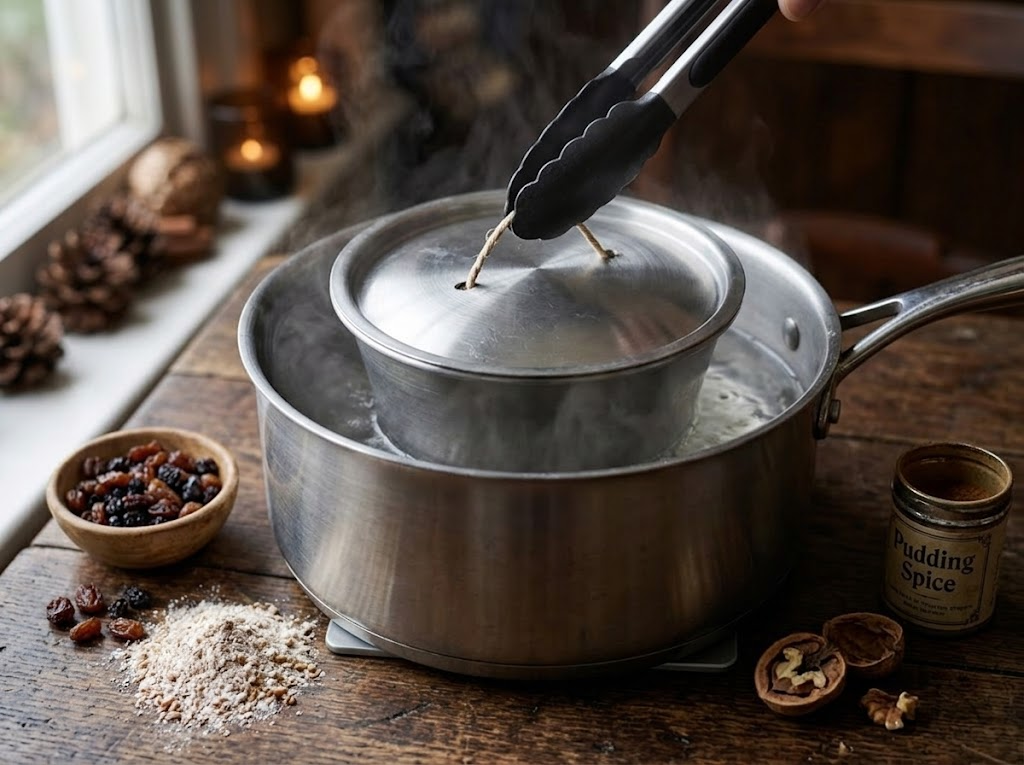
- Place a small trivet or upturned heatproof saucer in the base of a large deep saucepan. Set the pudding basin on top. Pour in boiling water to reach halfway up the side of the basin.
- Bring the water to a steady simmer over medium heat. Cover the saucepan tightly with its lid.
- Steam for 6 hours, checking the water level every 45 minutes. Top up with boiling water each time to keep it at the halfway mark. Do not let it boil dry.
- After 6 hours, test the pudding by pressing the centre firmly - it should feel set and firm. Insert a skewer: it should come out clean. If not, steam for a further 30 minutes.
- Lift the basin out using the string handle. Leave the pudding to cool completely in the basin, at least 3 hours.
Store and feed
- Once fully cool, remove the parchment and foil cover. Poke 8 to 10 holes across the surface with a skewer and spoon over 2 tablespoons of brandy.
- Re-cover with fresh parchment and foil, secured tightly with string. Store in a cool, dark place for up to 3 months. Feed with 2 tablespoons of brandy every 2 weeks.
Reheat and serve
- On Christmas Day, place the covered basin back in the steamer over simmering water. Steam for 2 hours, topping up the water as needed.
- To turn out, run a palette knife around the edge of the pudding. Place a warm plate over the basin and invert confidently. The pudding should release cleanly.
- To flame the pudding, warm 2 tablespoons of brandy in a small ladle over a gas flame until it is warm but not boiling. Pour over the pudding and light immediately with a long match. Bring to the table while the flames are still going.
Nutrition Facts
Servings 8
- Amount Per Serving
- Calories 420kcal
- % Daily Value *
- Total Fat 14g22%
- Saturated Fat 6g30%
- Cholesterol 55mg19%
- Sodium 140mg6%
- Potassium 480mg14%
- Total Carbohydrate 68g23%
- Dietary Fiber 4g16%
- Sugars 46g
- Protein 6g12%
- Vitamin A 180 IU
- Vitamin C 4 mg
- Calcium 75 mg
- Iron 3 mg
- Vitamin D 20 IU
- Vitamin E 1 mg
- Vitamin K 3 mcg
- Thiamin 0.18 mg
- Riboflavin 0.15 mg
- Niacin 2 mg
- Vitamin B6 0.2 mg
- Folate 22 mcg
- Vitamin B12 0.3 mcg
- Phosphorus 120 mg
- Magnesium 40 mg
- Zinc 1.2 mg
* Percent Daily Values are based on a 2,000 calorie diet. Your daily value may be higher or lower depending on your calorie needs.
Note
Additional Notes
- Soak dried fruit at least 12 hours ahead, or overnight, for the best plump texture.
- Pleat the parchment and foil cover to allow steam room as the pudding expands.
- Top up the steamer with boiling water every 45 minutes to avoid running dry.
- Cool the pudding fully before feeding with brandy and storing - wrapping warm traps condensation.
- Re-steam for exactly 2 hours on Christmas Day for a moist, even texture throughout.