
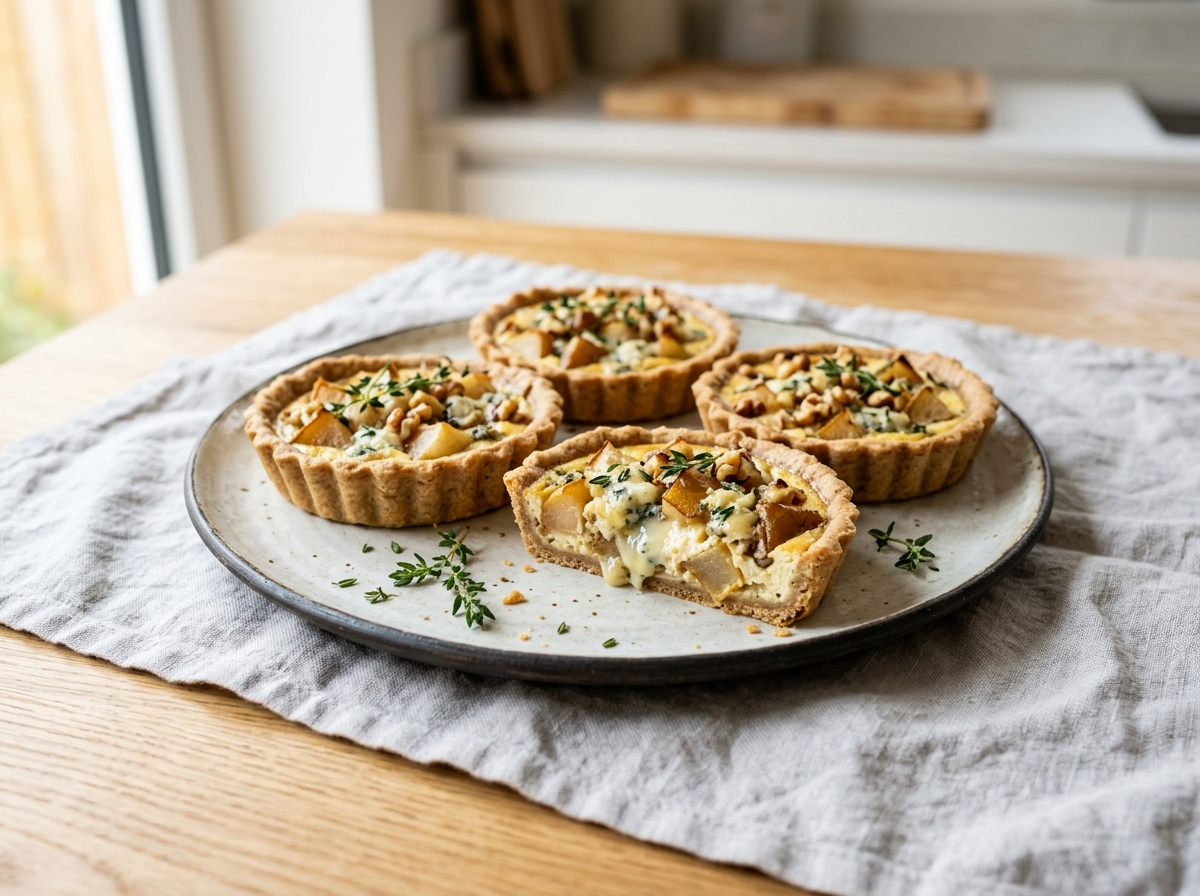
Spelt pastry has a short, crumbly texture that works well for individual tartlets. It holds a clean edge, bakes to a pale gold, and doesn’t shrink as much as standard shortcrust.
Blue cheese and pear is a pairing with real contrast. The salt and funk of the cheese cuts through the natural sugar of the pear. The filling stays balanced, not heavy.
These tartlets work as a starter for a dinner party or as a light lunch with a green salad. You can blind bake the shells ahead and fill them the day of serving.
Spelt flour is lower in gluten than wheat flour, which makes the dough forgiving to handle. It won’t turn tough if you work it a little longer than usual.
Why You’ll Love This Recipe
- Spelt pastry stays crisp without blind-bake weights
- Blue cheese and pear filling needs only 4 ingredients
- Shells can be baked a day ahead for easy entertaining
- Ready from scratch in 40 minutes flat
Ingredient Notes
- Spelt flour: Use white spelt flour for a lighter, more tender pastry. Wholegrain spelt works but gives a denser shell with a stronger nutty flavour.
- Blue cheese: Gorgonzola dolce melts smoothly and stays mild. Stilton gives a sharper result. Avoid very dry, crumbly blues as they don’t distribute evenly in the filling.
- Pear: Comice or Conference pears hold their shape when roasted. Avoid very ripe pears as they release too much liquid and soften the pastry base.
- Double cream: Double cream gives the custard set a rich, stable texture. Single cream or creme fraiche will also work but the set will be slightly softer.
- Cold butter: Keep butter cold and in small cubes before rubbing into the flour. Cold fat creates a flaky, short pastry rather than a dense one.
- Walnuts: Toasted walnuts add crunch and a bitter note that anchors the sweet pear. Pecans are a workable swap if walnuts aren’t available.
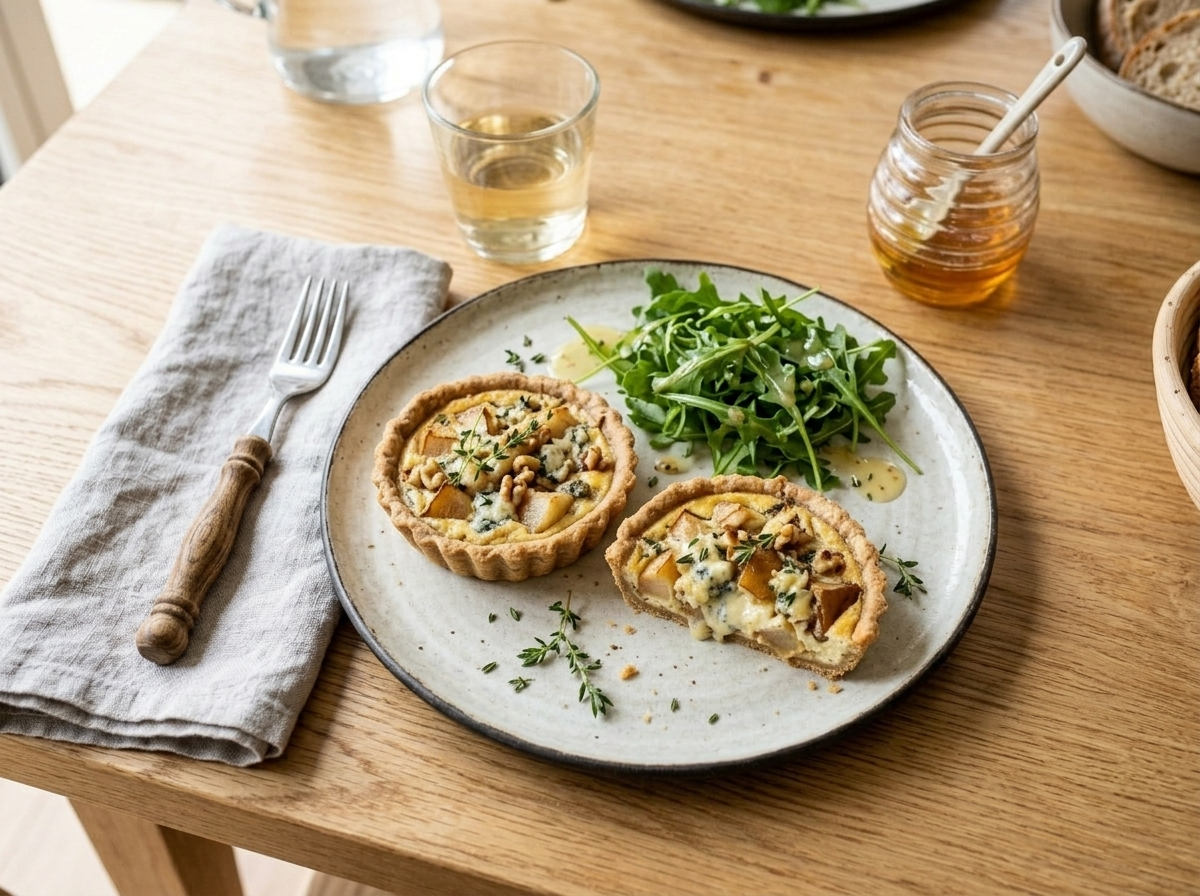
Spelt Blue Cheese and Pear Tartlets
Description
Spelt flour gives the pastry a nutty, slightly earthy base that holds its shape and stays crisp under the filling. The sharpness of blue cheese and the soft sweetness of roasted pear balance each other cleanly.
Ingredients
Spelt Pastry
Filling
Instructions
Make the pastry
- Heat the oven to 200 C / 390 F.
- Put the spelt flour and salt into a mixing bowl. Add the cold butter cubes and rub them into the flour with your fingertips until the mixture looks like coarse breadcrumbs.
- Add cold water one tablespoon at a time, mixing with a fork after each addition, until the dough just comes together. Do not over-work it.
- Flatten the dough into a disc, wrap it in cling film, and refrigerate for 20 minutes.
Roast the pear
- Toss the pear cubes with olive oil on a small roasting tray. Spread in a single layer.
- Roast at 200 C / 390 F for 12 to 15 minutes until the edges are lightly golden and the pear is just tender. Set aside to cool.
Line and blind bake the shells
- On a lightly floured surface, roll the chilled pastry to about 3 mm thickness. Cut four rounds large enough to line your 10 cm tartlet tins with a small overhang.
- Press each round gently into a tin, trimming any excess with a sharp knife. Prick the base three to four times with a fork.
- Chill the lined tins for 15 minutes in the refrigerator.
- Line each shell with a small piece of baking parchment and fill with baking beans or dried rice. Blind bake at 200 C / 390 F for 10 minutes until the edges are dry and pale.
- Remove the parchment and beans. Return to the oven for 3 minutes until the base looks dry and just starting to colour. Remove and reduce the oven to 180 C / 355 F.
Fill and bake
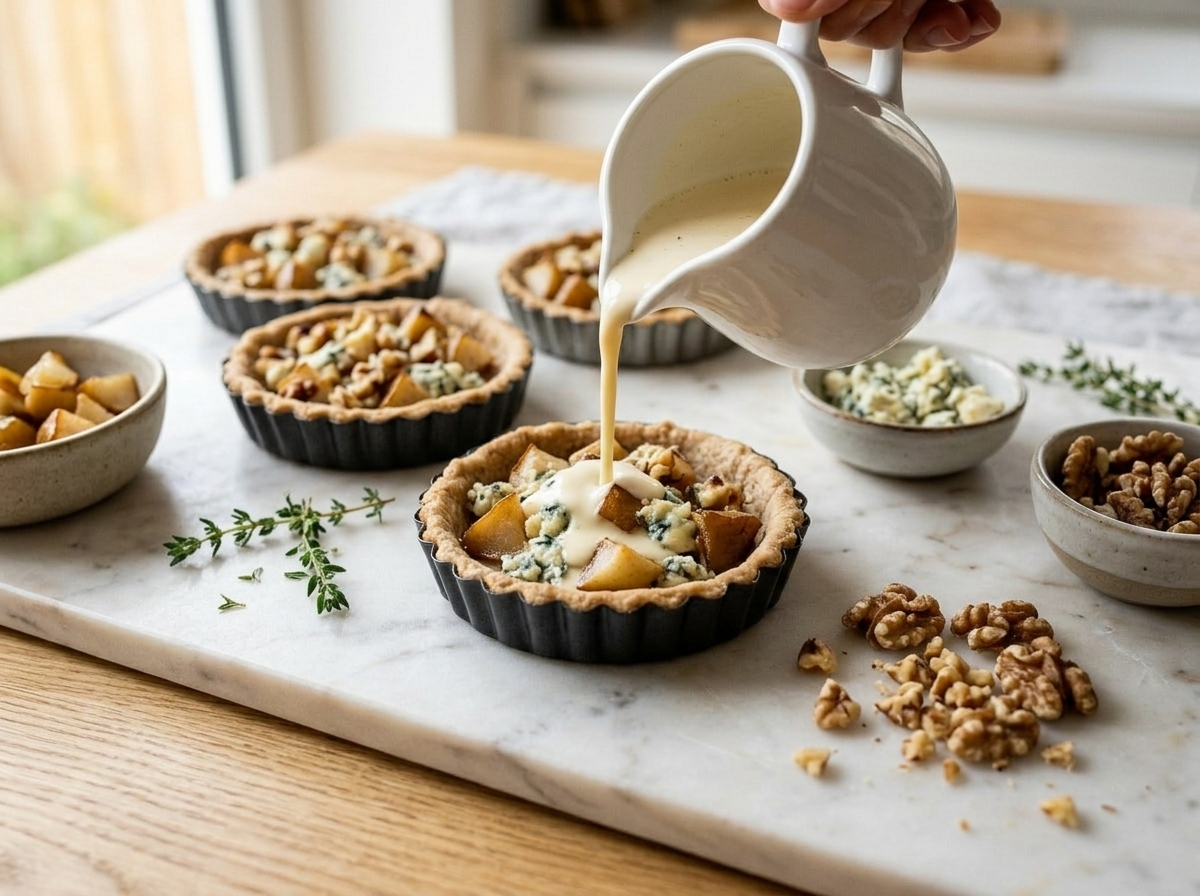
- Whisk the eggs and double cream together in a jug. Season with black pepper and stir in the thyme leaves if using.
- Divide the roasted pear evenly among the four shells. Scatter the crumbled blue cheese and chopped walnuts over the pear.
- Pour the cream and egg mixture slowly into each shell until it reaches just below the rim.
- Bake at 180 C / 355 F for 18 to 20 minutes until the filling has a slight wobble in the centre and the top is lightly golden.
- Rest the tartlets in their tins for 5 minutes before carefully removing and serving warm.
Nutrition Facts
Servings 4
- Amount Per Serving
- Calories 480kcal
- % Daily Value *
- Total Fat 33g51%
- Saturated Fat 17g85%
- Cholesterol 155mg52%
- Sodium 520mg22%
- Potassium 210mg6%
- Total Carbohydrate 38g13%
- Dietary Fiber 4g16%
- Sugars 7g
- Protein 13g26%
- Vitamin A 720 IU
- Vitamin C 4 mg
- Calcium 160 mg
- Iron 2 mg
- Vitamin D 40 IU
- Vitamin E 1.5 mg
- Vitamin K 8 mcg
- Thiamin 0.2 mg
- Riboflavin 0.3 mg
- Niacin 3 mg
- Vitamin B6 0.2 mg
- Folate 35 mcg
- Vitamin B12 0.6 mcg
- Phosphorus 220 mg
- Magnesium 40 mg
- Zinc 1.8 mg
* Percent Daily Values are based on a 2,000 calorie diet. Your daily value may be higher or lower depending on your calorie needs.
Note
Additional Notes
- Chill the pastry-lined tins for 15 minutes before baking to prevent the sides from slumping.
- Cut pear into 1 cm cubes so they roast quickly and don't release water into the shell.
- Crumble blue cheese coarsely so you get uneven pockets of flavour rather than a uniform spread.
- Blind bake shells at 190 C until just dry, not golden, before adding filling.
- Let the egg and cream mixture come to room temperature before pouring to ensure an even bake.