Walnut and Blue Cheese Scones

Servings: 8 Total Time: 40 mins Difficulty: Easy
Flaky, savory scones with bold cheese and crunchy walnuts.
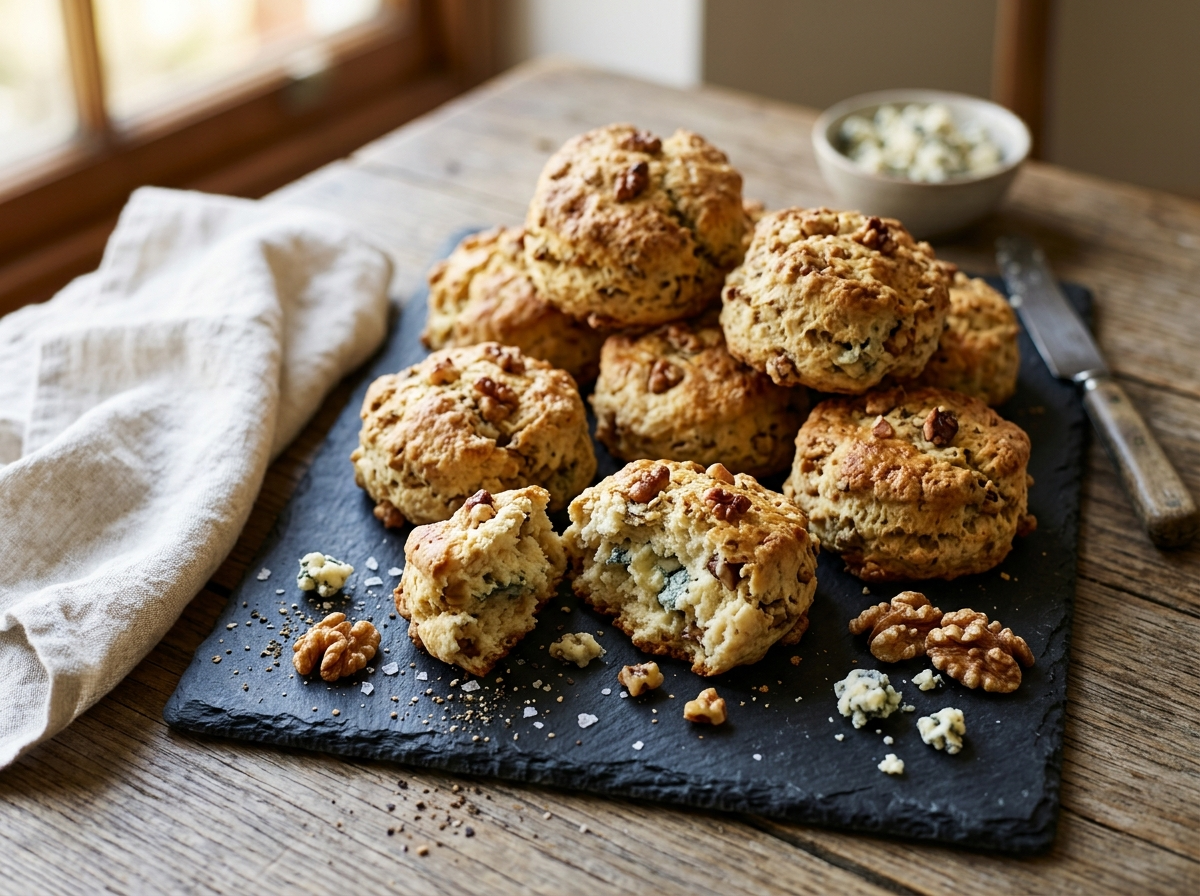
Golden walnut and blue cheese scones on a slate board, one broken open to show soft crumb and cheese pockets View Gallery 2 photos

These scones sit somewhere between bread and pastry. The blue cheese melts into the dough during baking, leaving pockets of sharp, creamy flavor throughout each layer.

Walnuts add a firm crunch that stays distinct even after baking. That contrast of soft crumb and nutty texture is what makes them satisfying rather than heavy.

They work at room temperature, but they’re best pulled apart warm, straight from the oven. The crumb stays open and light. The crust crisps at the edges.

You can mix the dough in under 15 minutes. One bowl, no mixer, no special equipment.

Why You’ll Love This Recipe

  • Bold blue cheese flavor baked into every layer
  • Ready in 40 minutes with one mixing bowl
  • Crisp top, soft crumb, no mixer required
  • Freezer-friendly dough you can bake from cold

Unbaked blue cheese and walnut scone rounds on parchment being brushed with egg wash before baking

Ingredient Notes

  • Blue cheese: Gorgonzola, Stilton, or Roquefort all work well. Stilton gives a firmer crumble and a slightly milder flavor than Gorgonzola.
  • Walnuts: Roughly chop them so you get visible chunks in each scone. Lightly toasting them in a dry pan for 2 minutes before adding deepens the flavor.
  • Cold butter: Keep the butter as cold as possible right up until mixing. Cold butter creates steam pockets during baking, which is what lifts the layers.
  • Self-raising flour: If you only have plain flour, add 2 tsp baking powder per 200 g. Spelt self-raising flour works as a direct swap and adds a mild nutty note.
  • Buttermilk: Buttermilk gives the crumb a slight tang and reacts with the baking powder for a better rise. Substitute with whole milk plus 1 tsp lemon juice, left to sit for 5 minutes.
  • Egg: One beaten egg is used for the glaze. It gives the top a golden, glossy finish. You can skip it and brush with milk instead for a paler crust.
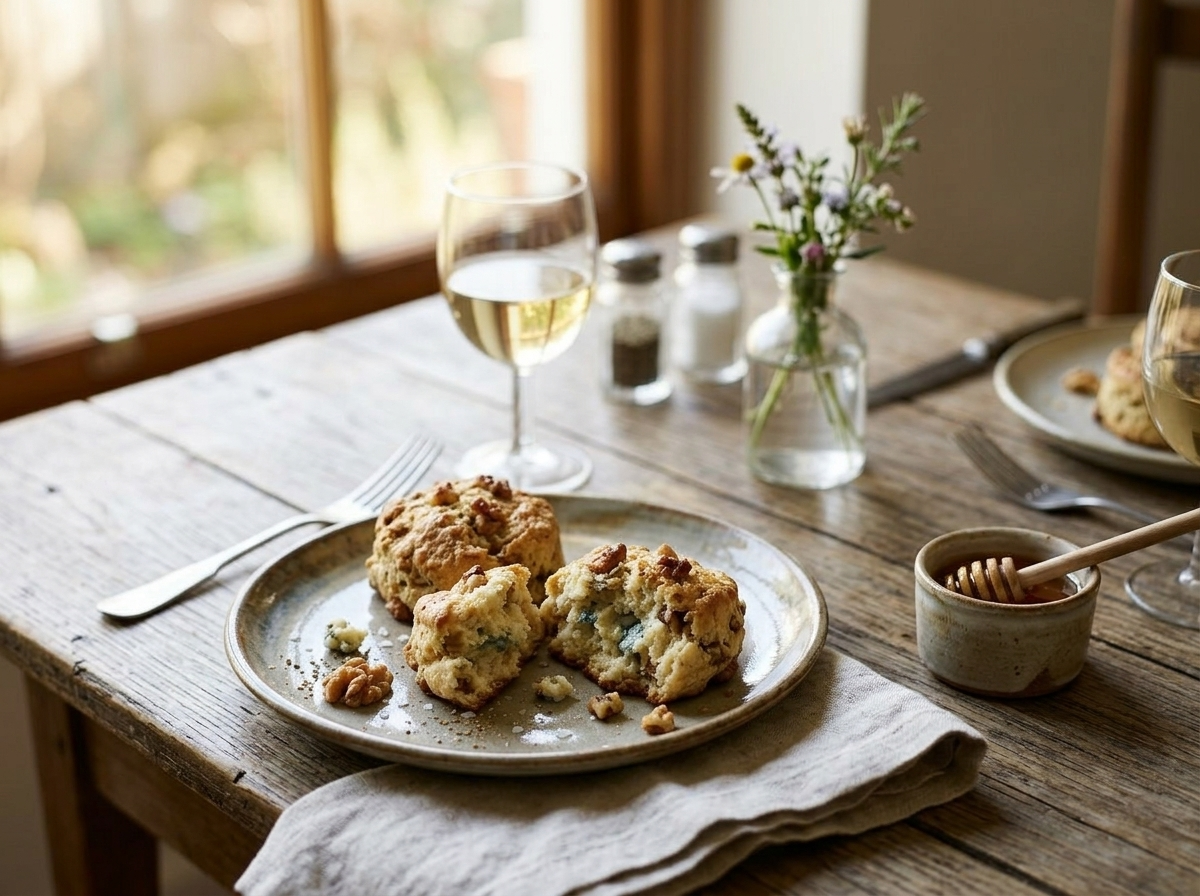
Two walnut and blue cheese scones on a ceramic plate with honey and a glass of white wine

Difficulty: Easy Prep Time 15 mins Cook Time 22 mins Rest Time 3 mins Total Time 40 mins
Cooking Temp: 200  C Servings: 8 Estimated Cost: £ 0.85 Calories: 295

Description

The combination of sharp blue cheese and toasted walnuts melts into the dough as it bakes, giving each scone a rich, layered flavor with a crisp top and soft crumb.

Ingredients

Cooking Mode Disabled

Instructions

  1. Heat the oven to 200 C / 390 F. Line a baking sheet with parchment paper.
  2. Put the flour, baking powder, salt, and pepper into a large mixing bowl. Stir briefly to combine.
  3. Add the cold butter cubes. Rub the butter into the flour using your fingertips until the mixture looks like coarse breadcrumbs with some pea-sized lumps remaining.
  4. Add the crumbled blue cheese and chopped walnuts. Toss gently through the flour mixture so they distribute evenly.
  5. Pour in the cold buttermilk. Use a fork or your hand to bring the dough together with as few strokes as possible. Stop as soon as no dry flour remains.
  6. Turn the dough out onto a lightly floured surface. Pat it gently into a disc about 3 cm thick. Do not knead.
  7. Press a 5 cm round cutter straight down into the dough without twisting. Lift out each round and place on the prepared baking sheet so they are just touching. Re-pat the scraps once to cut remaining rounds.
  8. Brush the tops with beaten egg. Bake on the middle rack for 20 to 22 minutes until the tops are deep golden and the sides look set and dry.
  9. Transfer to a wire rack. Leave for 3 minutes before serving so the crumb firms up slightly.

Nutrition Facts

Servings 8


Amount Per Serving
Calories 295kcal
% Daily Value *
Total Fat 16g25%
Saturated Fat 7g35%
Cholesterol 52mg18%
Sodium 480mg20%
Potassium 130mg4%
Total Carbohydrate 30g10%
Dietary Fiber 1.5g6%
Sugars 1g
Protein 9g18%

Vitamin A 310 IU
Calcium 110 mg
Iron 2 mg
Vitamin D 14 IU
Vitamin E 0.6 mg
Vitamin K 2 mcg
Thiamin 0.18 mg
Riboflavin 0.15 mg
Niacin 2 mg
Vitamin B6 0.1 mg
Folate 22 mcg
Vitamin B12 0.3 mcg
Phosphorus 160 mg
Magnesium 28 mg
Zinc 1.2 mg

* Percent Daily Values are based on a 2,000 calorie diet. Your daily value may be higher or lower depending on your calorie needs.

Note

Additional Notes

  • Keep butter in the freezer for 10 minutes before rubbing in for maximum flakiness.
  • Do not overwork the dough once buttermilk is added - mix just until it comes together.
  • Pat dough to exactly 3 cm thick for tall, well-risen scones.
  • Toasting walnuts before adding to the dough intensifies their flavor noticeably.
  • Bake scones touching each other so they support each other and rise evenly.
Keywords: walnut and blue cheese scones, savory scones, blue cheese scone recipe, easy scone recipe, savoury baking

Equipment

  • Large mixing bowl
  • Pastry cutter or box grater (for butter)
  • 5 cm round biscuit cutter
  • Baking sheet
  • Pastry brush
  • Wire cooling rack

Tips

  • Handle the dough as little as possible once the liquid is added, or the scones will be dense.
  • Pat the dough to 3 cm thick before cutting to get enough height for a good rise.
  • Press the cutter straight down without twisting - twisting seals the edges and blocks the rise.
  • Place scones touching each other on the tray so they rise upward rather than spreading out.
  • Bake on the middle rack at 200 C / 390 F for 20 to 22 minutes until the tops are deep golden.

Variations

  • Swap walnuts for pecans and use a mild goat cheese instead of blue cheese for a softer flavor.
  • Add 1 tsp fresh thyme leaves to the dough for an herby, aromatic version that pairs with soup.
  • Stir in 2 tbsp finely chopped dried cranberries for a sweet-salty contrast against the blue cheese.

Storage and Reheating

Store cooled scones in an airtight container at room temperature for up to 2 days. After that, the texture softens and the crust loses its crispness.

To reheat, place scones on a baking sheet in a 180 C / 355 F oven for 6 to 8 minutes. This brings back the crisp top without drying the crumb. Avoid the microwave - it makes the texture gummy.

To freeze, wrap individual scones in plastic wrap and store in a freezer bag for up to 2 months. Bake from frozen at 190 C / 375 F for 14 to 16 minutes.

Serving Suggestions

Serve warm with a thin spread of butter or a drizzle of honey. The honey cuts through the sharpness of the blue cheese without masking it.

They pair well alongside a bowl of roasted tomato soup or a simple green salad with a sharp vinaigrette. The scones work as the bread component of a light lunch.

For a cheese board setting, arrange them alongside sliced pears, grapes, and a little fig jam. They hold up well at room temperature for 30 to 40 minutes without going stale.

Frequently Asked Questions

Expand All:

Why are my walnut and blue cheese scones flat and not rising?

The most common cause is twisting the cutter when you stamp out the rounds, which seals the edges and stops them rising. Make sure your baking powder is fresh and your butter was cold before mixing.

Can I use cheddar instead of blue cheese in these scones?

Yes, a sharp aged cheddar works. The flavor will be milder and less pungent, but the texture stays the same. Increase the amount to 120 g since cheddar is less intense than blue cheese.

Can I freeze the unbaked walnut and blue cheese scone dough?

Cut the dough into rounds, place them on a lined tray, and freeze until solid, then transfer to a bag. Bake straight from frozen at 190 C / 375 F for about 15 minutes.

What goes well with blue cheese scones on a cheese board?

Sliced pears, fresh walnuts, fig jam, and a small pot of honey all complement the sharp blue cheese. A glass of off-dry white wine or a light red also works well alongside them.

Are walnut and blue cheese scones suitable for vegetarians?

They are vegetarian if you use a blue cheese made with non-animal rennet, such as some Gorgonzola varieties. Check the label, since traditional Stilton and Roquefort use animal rennet.

How do I know when the scones are fully baked?

The tops should be deep golden brown and the sides should look dry and set, not pale or doughy. If you tap the base, it should sound hollow rather than dense.

Min
Share it on your social network