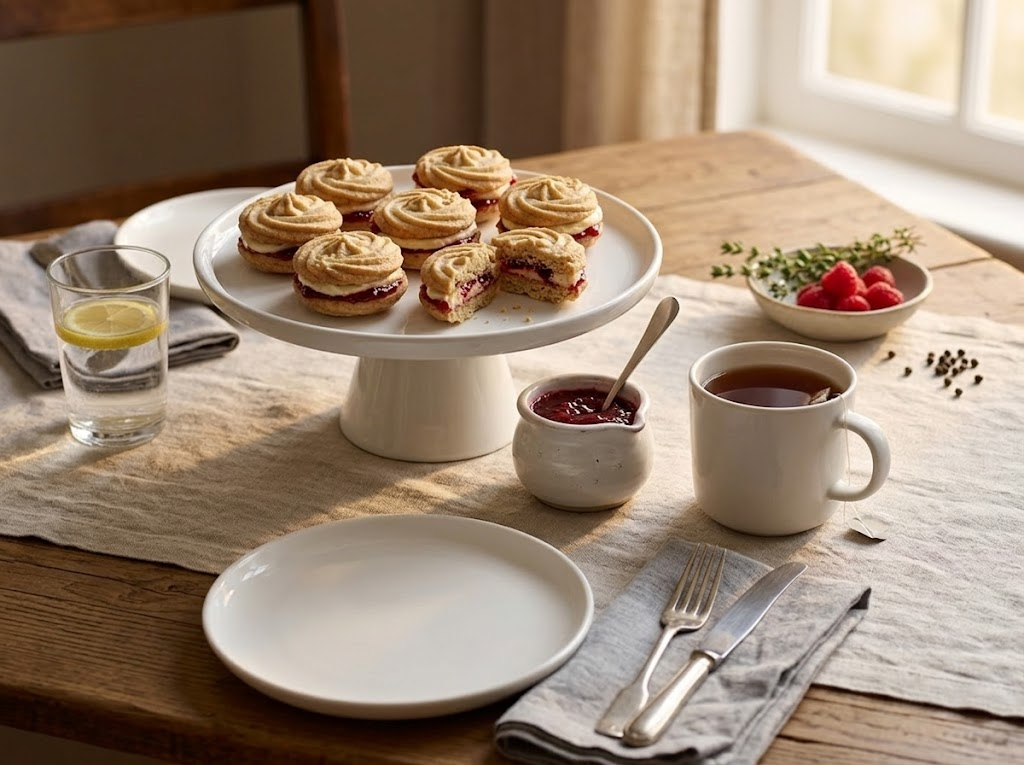

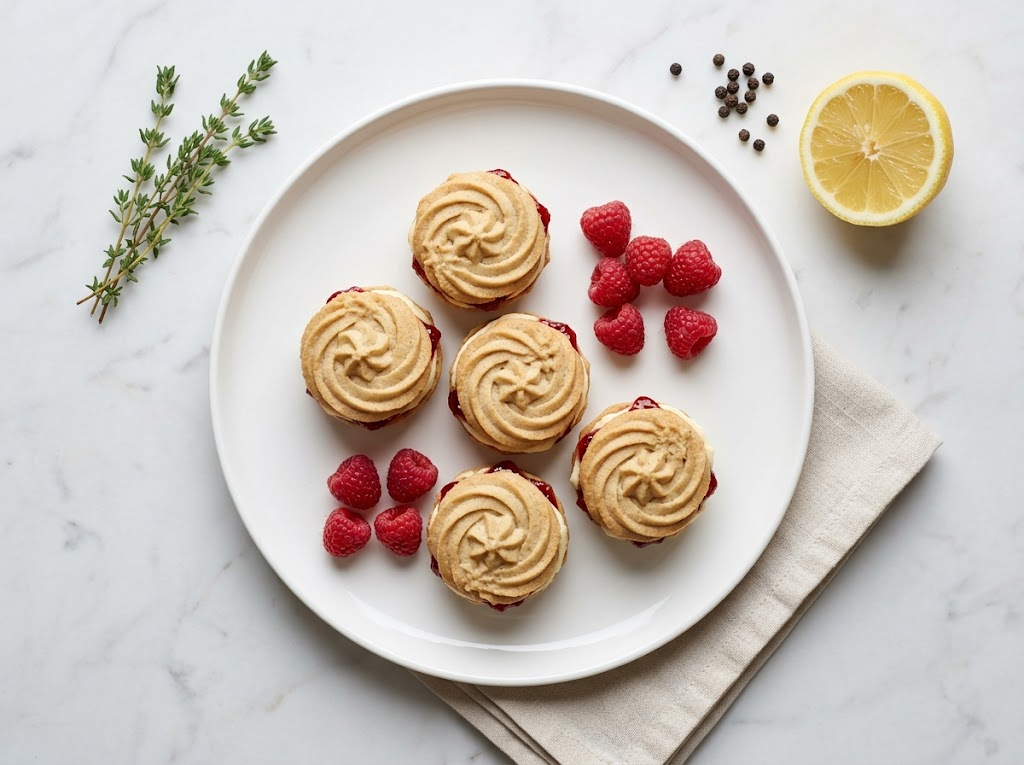
Viennese whirls are one of those biscuits that look harder than they are. The dough is essentially a very soft, buttery shortbread, and swapping plain flour for white spelt flour adds a gentle nuttiness without changing the method at all.
Spelt has a slightly lower gluten strength than wheat, which actually works in your favour here. The baked biscuits stay tender and short, with a clean snap when you bite through the buttercream filling.
The key is getting the butter soft enough that the dough pipes smoothly through a large star nozzle. Too cold and the dough tears. Too warm and the rosettes spread flat in the oven.

I fill mine with a thin layer of raspberry jam and a swirl of vanilla buttercream. The jam cuts through the richness and keeps each bite balanced.
Why You’ll Love This Recipe
- Spelt flour adds nutty depth to classic shortbread dough
- Crisp exterior with a soft, melt-in-mouth centre
- No chill time needed, ready to bake straight away
- Makes an elegant gift or afternoon tea centrepiece
Ingredient Notes
- white spelt flour: Use white spelt rather than wholemeal here. Wholemeal spelt makes the dough too heavy to pipe cleanly. Plain wheat flour works as a direct swap if needed.
- unsalted butter: The butter must be very soft, around 20-22 C / 68-72 F. Cold butter will block the piping nozzle and tear the dough as it comes through.
- icing sugar: Sift the icing sugar before beating it into the butter. Lumps in the dough can clog the piping bag nozzle mid-session.
- cornflour: A small amount of cornflour mixed with the spelt flour gives the biscuits their characteristic melt-in-the-mouth texture. Arrowroot powder works as a substitute.
- vanilla extract: Use extract rather than essence for a cleaner flavour in both the dough and the buttercream. Vanilla bean paste also works well.
- raspberry jam: A smooth, seedless jam makes assembly neater. Strawberry or apricot jam are equally good. Use about half a teaspoon per biscuit sandwich.
Spelt Viennese Whirls
Description
Spelt flour gives these piped shortbread biscuits a slightly nutty depth that plain flour can't match. The dough stays soft enough to pipe cleanly and bakes to a crisp, melt-in-the-mouth texture.
Ingredients
Biscuit dough
Vanilla buttercream
Filling
Instructions
Make the biscuit dough
- Heat the oven to 180 C / 350 F. Line two flat baking sheets with parchment paper.
- Beat the soft butter and sifted icing sugar together with electric beaters on medium-high speed for 4 minutes, until pale and noticeably fluffy.
- Add the vanilla extract and salt, then beat for another 30 seconds.
- Sift the white spelt flour and cornflour together directly into the bowl. Fold in gently with a spatula until the dough just comes together. Do not overwork it.
- Transfer the dough to a large piping bag fitted with a large open star nozzle.
Pipe and bake
- Pipe 24 rosettes onto the prepared baking sheets, each about 4 cm wide. Hold the bag straight up and release pressure in a slow, steady spiral, finishing with a small upward flick.
- Space the rosettes at least 3 cm apart. If the kitchen is warm, refrigerate the trays for 10 minutes before baking.
- Bake on the middle shelf for 12 to 14 minutes, until the bases are pale golden and the edges just start to colour. The tops will still look pale.
- Remove from the oven and leave on the tray for 5 minutes before transferring carefully to a wire rack. Cool completely before filling.
Make the buttercream and assemble
- Beat the softened butter with electric beaters for 3 minutes until very pale. Add the sifted icing sugar in two additions, beating well after each. Add the vanilla extract and milk, then beat for 2 more minutes until light and smooth.
- Match the cooled biscuits into pairs of similar size.
- Spread or pipe a small swirl of buttercream onto the flat side of one biscuit from each pair.
- Add half a teaspoon of raspberry jam on top of the buttercream, slightly off-centre so it peeks out at the edge when sandwiched.
- Press the second biscuit gently on top, flat side down, until the filling reaches the edge. Repeat with the remaining pairs.
Nutrition Facts
Servings 12
- Amount Per Serving
- Calories 218kcal
- % Daily Value *
- Total Fat 14g22%
- Saturated Fat 9g45%
- Cholesterol 37mg13%
- Sodium 18mg1%
- Potassium 45mg2%
- Total Carbohydrate 23g8%
- Dietary Fiber 1g4%
- Sugars 13g
- Protein 2g4%
- Vitamin A 430 IU
- Calcium 10 mg
- Iron 1 mg
- Vitamin D 14 IU
- Vitamin E 0.5 mg
- Vitamin K 2 mcg
- Thiamin 0.08 mg
- Riboflavin 0.04 mg
- Niacin 0.8 mg
- Vitamin B6 0.02 mg
- Folate 8 mcg
- Vitamin B12 0.05 mcg
- Phosphorus 55 mg
- Magnesium 12 mg
- Zinc 0.4 mg
* Percent Daily Values are based on a 2,000 calorie diet. Your daily value may be higher or lower depending on your calorie needs.
Note
Additional Notes
- Butter temperature is the single most important factor. Aim for 20-22 C for clean piping.
- Sift both the icing sugar and cornflour directly into the bowl to avoid lumps in the dough.
- Bake on the middle shelf only. The top shelf runs hotter and colours the biscuits unevenly.
- Let baked biscuits cool on the tray for 5 minutes before moving. They are fragile when warm.
- For the buttercream, beat softened butter for 3 minutes before adding icing sugar for a lighter, less dense filling.