
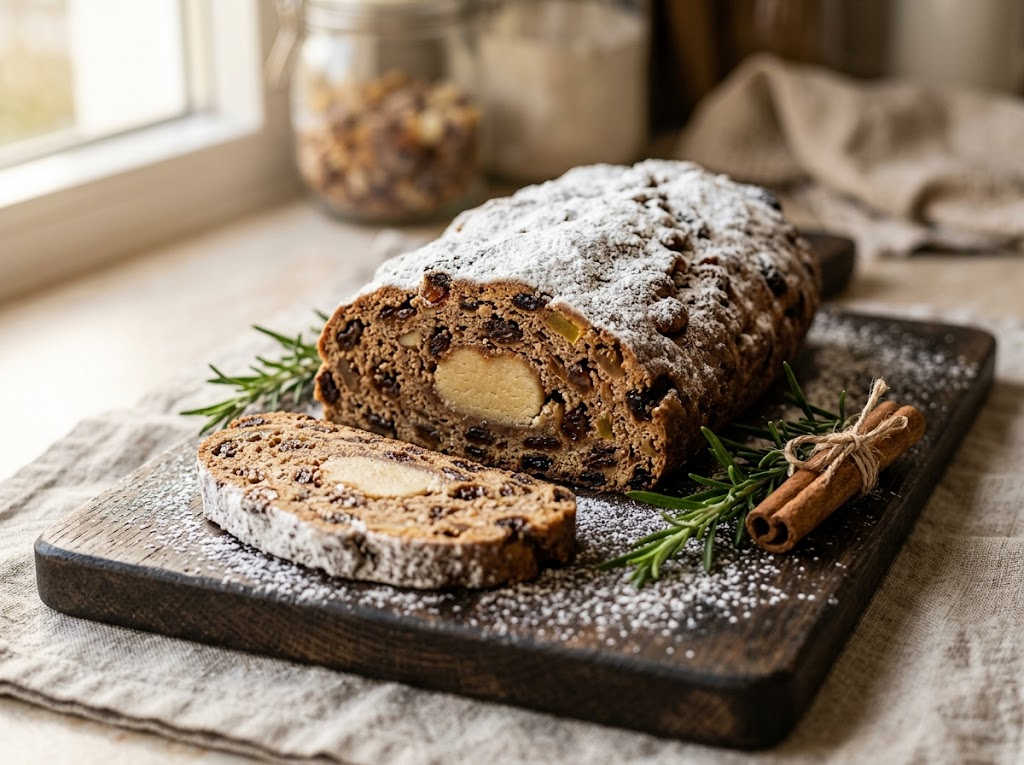
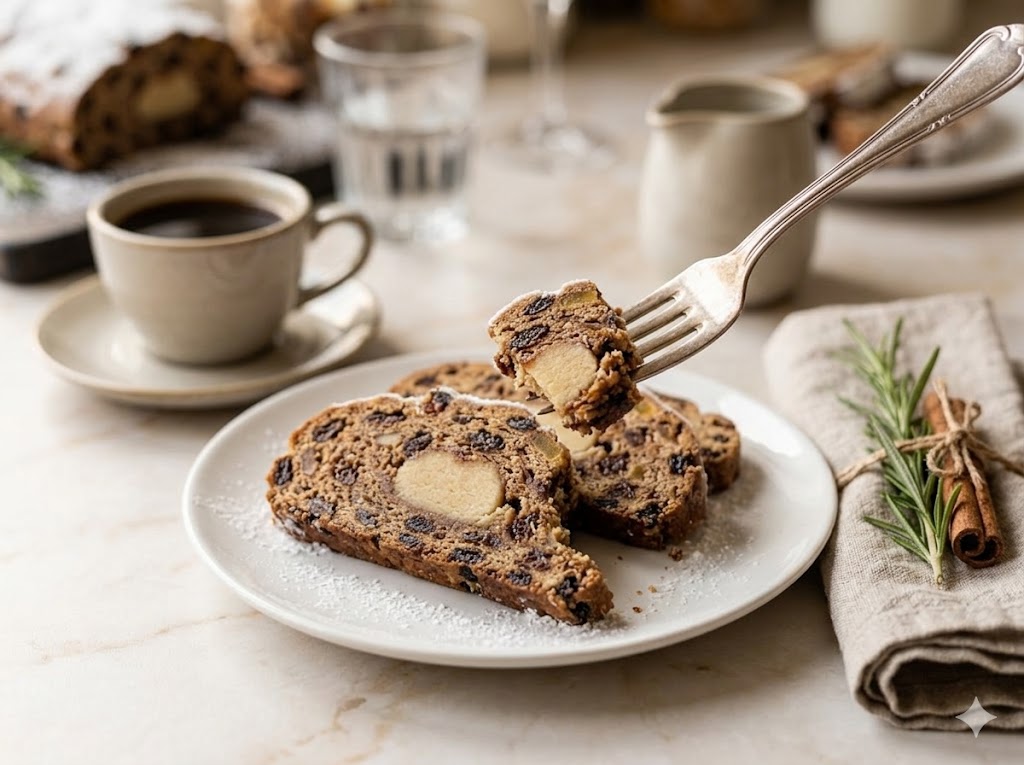
Stollen is a German festive bread built on enriched dough, dried fruit, and a core of marzipan. Using spelt flour keeps the crumb lighter than the traditional wheat version, while the flavour stays just as warm and complex.
The dough uses whole milk, butter, and egg yolks to stay rich without being heavy. Spelt has a lower gluten elasticity than bread flour, so it handles carefully – you mix until just combined, not until springy.
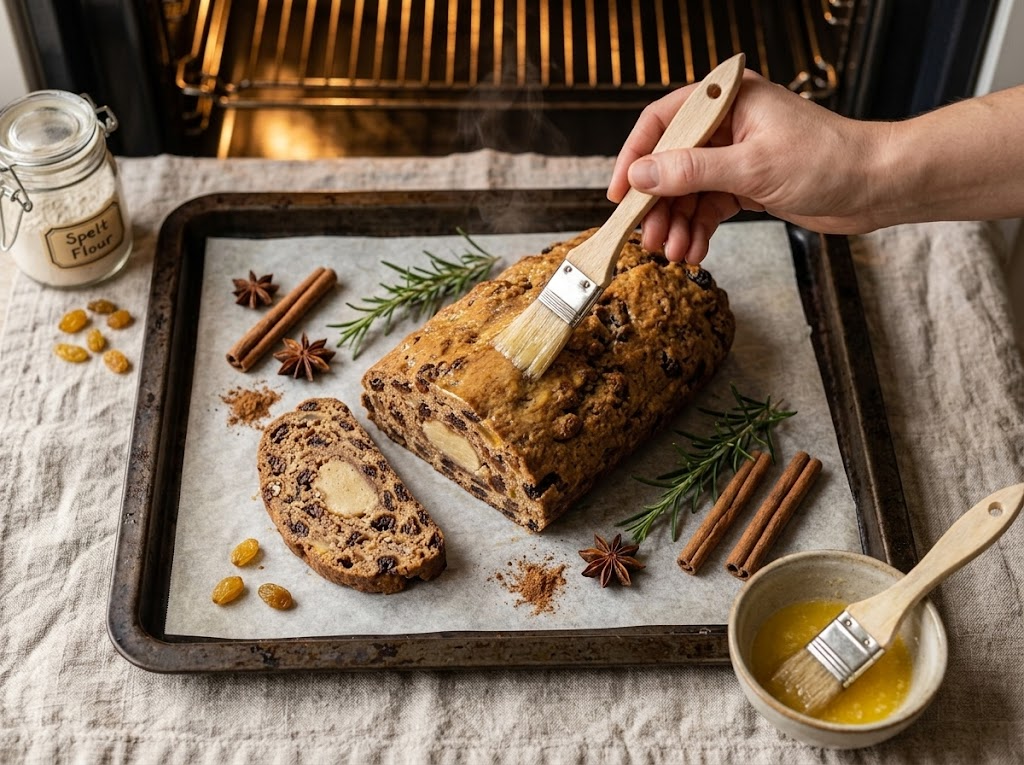
Rum-soaked raisins and mixed peel go in last, folded gently so the fruit stays evenly distributed. After baking, the loaf gets brushed with melted butter and dusted with icing sugar, which forms a thin, slightly crisp coating as it cools.
Why You’ll Love This Recipe
- Spelt flour gives a lighter crumb than wheat stollen
- Marzipan centre stays soft and distinct when sliced
- Flavour deepens over 2 to 3 days of resting
- Make-ahead friendly – keeps well for up to two weeks
Ingredient Notes
- White spelt flour: Use white spelt flour rather than wholegrain here – it gives a softer crumb and handles enriched doughs better. Wholegrain spelt makes the loaf dense and harder to shape.
- Instant dried yeast: Instant yeast goes straight into the flour with no pre-activation needed. If using fresh yeast, use 21 g and dissolve it in the warm milk first.
- Unsalted butter: Butter should be soft but not melted – it incorporates evenly into spelt dough without overworking the gluten. Coconut oil works as a dairy-free swap but changes the flavour noticeably.
- Marzipan: Use a firm, shop-bought marzipan with at least 25 percent almond content. Soft or homemade marzipan can leak into the dough during baking.
- Rum-soaked mixed fruit: Soak raisins and mixed peel in dark rum for at least one hour, or overnight for stronger flavour. If you prefer alcohol-free, use warm orange juice instead.
- Whole milk: Warm milk to about 40 C / 104 F – warm enough to activate yeast but not hot enough to kill it. Oat milk works well as a non-dairy substitute.
Spelt Stollen Bread
Description
Spelt flour gives this stollen a slightly nutty, open crumb that absorbs the rum-soaked fruit without turning dense. The marzipan centre stays soft through baking, giving a clean contrast to the spiced dough.
Ingredients
Fruit soak
Stollen dough
Filling
Finishing
Instructions
Soak the fruit
- Combine the raisins and mixed peel in a bowl. Pour over the rum or orange juice, stir, cover, and leave to soak for at least 1 hour or overnight. Drain any unabsorbed liquid before using.
Make the dough
- In a large mixing bowl or the bowl of a stand mixer, combine the spelt flour, yeast, caster sugar, salt, cinnamon, cardamom, and nutmeg. Stir to distribute evenly.
- Add the warm milk, softened butter, egg yolks, vanilla extract, and lemon zest. Mix on low speed with a dough hook, or by hand, for 3 to 4 minutes until a soft, slightly sticky dough forms. Do not over-mix.
- Add the drained soaked fruit and chopped almonds. Fold in gently using a spatula or your hands until evenly distributed through the dough.
- Cover the bowl with a clean cloth or cling film. Leave to prove in a warm spot for 1 hour, or until the dough has puffed up noticeably. Spelt dough won't double in size like wheat dough - a 50 percent increase is enough.
Shape the stollen
- Heat the oven to 180 C / 355 F. Line a large baking sheet with parchment paper.
- Turn the dough onto a lightly floured surface. Press or roll it gently into a rectangle roughly 30 x 22 cm.
- Roll the marzipan into a log about 25 cm long. Place it slightly off-centre along the length of the dough.
- Fold the larger side of the dough over the marzipan log, then press the edge down firmly to seal. The classic stollen shape is asymmetric, with one side slightly higher than the other.
- Transfer the shaped loaf to the prepared baking sheet. Cover loosely with oiled cling film and rest for 30 minutes at room temperature until slightly puffed.
Bake and finish
- Bake on the middle rack for 40 to 45 minutes, until deep golden brown all over. The internal temperature (avoiding the marzipan) should reach 90 to 93 C / 194 to 200 F.
- Remove from the oven. While still hot, brush the entire surface generously with melted butter. Leave for 5 minutes, then brush again with a second coat.
- Leave the stollen to cool completely on a wire rack, at least 1 hour. Sift icing sugar thickly and evenly over the entire surface to form a white coating. Wrap tightly in baking paper then foil and rest for at least 24 hours before slicing.
Nutrition Facts
Servings 12
- Amount Per Serving
- Calories 310kcal
- % Daily Value *
- Total Fat 12g19%
- Saturated Fat 6g30%
- Cholesterol 50mg17%
- Sodium 110mg5%
- Potassium 180mg6%
- Total Carbohydrate 44g15%
- Dietary Fiber 3g12%
- Sugars 22g
- Protein 6g12%
- Vitamin A 240 IU
- Vitamin C 1 mg
- Calcium 40 mg
- Iron 2 mg
- Vitamin D 12 IU
- Vitamin E 1.2 mg
- Vitamin K 2 mcg
- Thiamin 0.2 mg
- Riboflavin 0.1 mg
- Niacin 2 mg
- Vitamin B6 0.1 mg
- Folate 20 mcg
- Vitamin B12 0.2 mcg
- Phosphorus 120 mg
- Magnesium 28 mg
- Zinc 0.8 mg
* Percent Daily Values are based on a 2,000 calorie diet. Your daily value may be higher or lower depending on your calorie needs.
Note
Additional Notes
- Soak fruit for at least 1 hour, preferably overnight, before mixing into the dough.
- Do not let the dough over-proof - spelt weakens quickly and a collapsed loaf won't recover.
- Brush with butter twice while hot to build a proper protective crust under the icing sugar.
- Rest the finished stollen for at least 24 hours before cutting for best flavour and texture.
- Weigh all ingredients - volume measures are unreliable for enriched spelt doughs.