
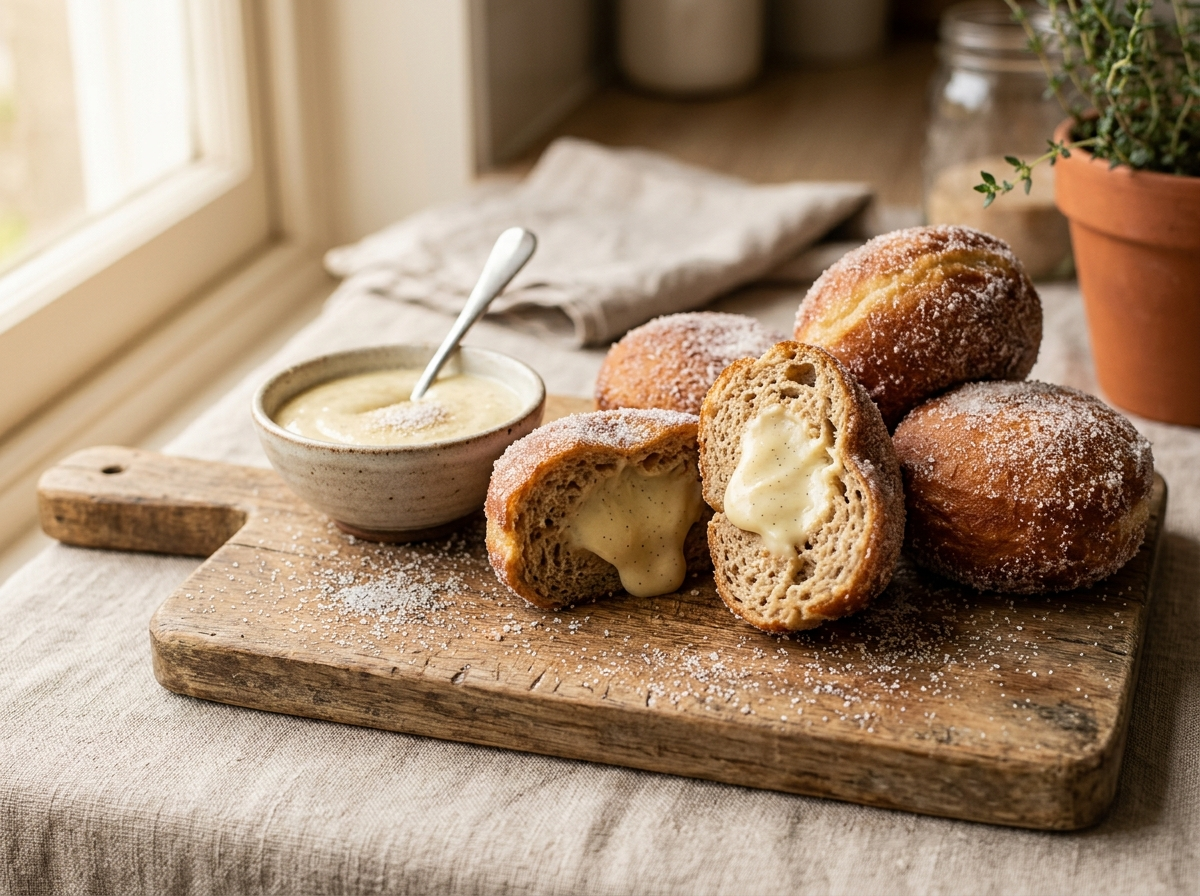
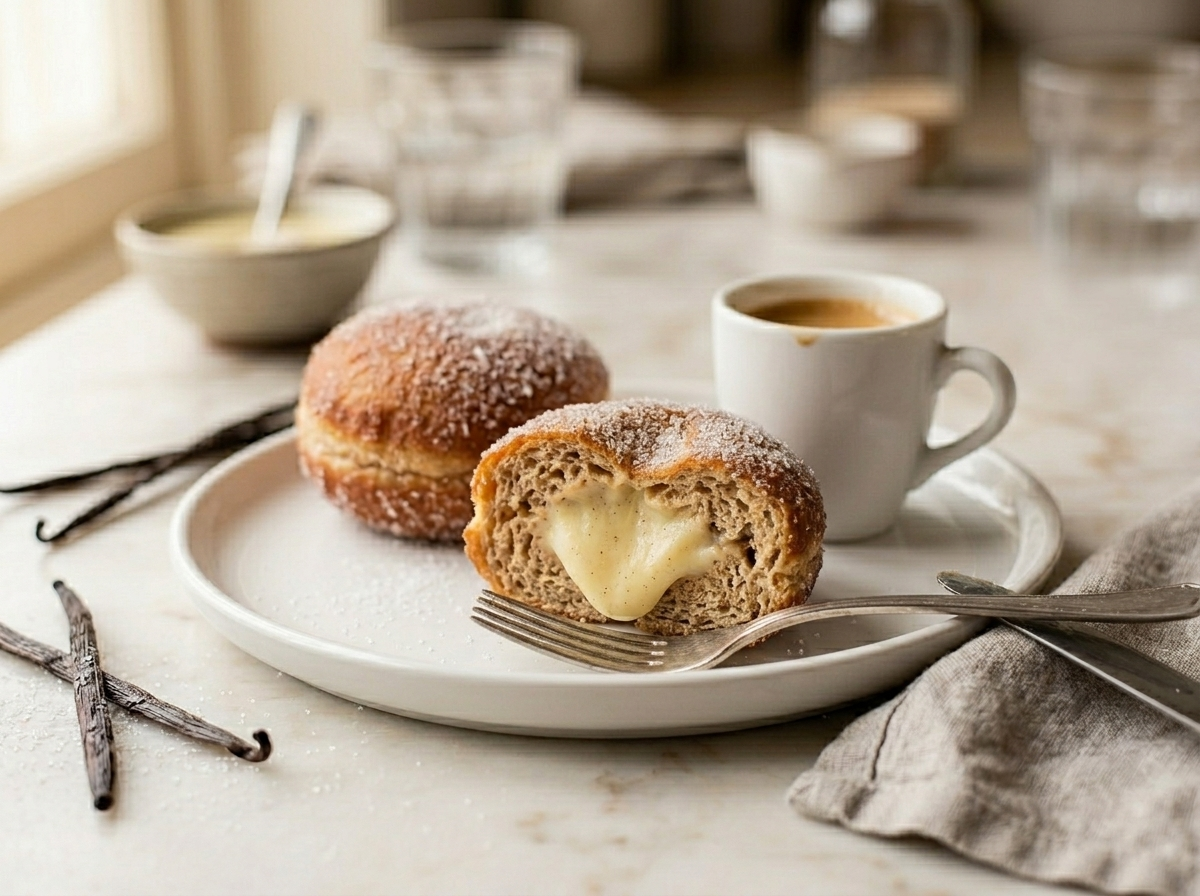
These doughnuts use white spelt flour in place of plain wheat flour, which gives the dough a softer crumb and a faint nuttiness that works well against the sweet custard filling.
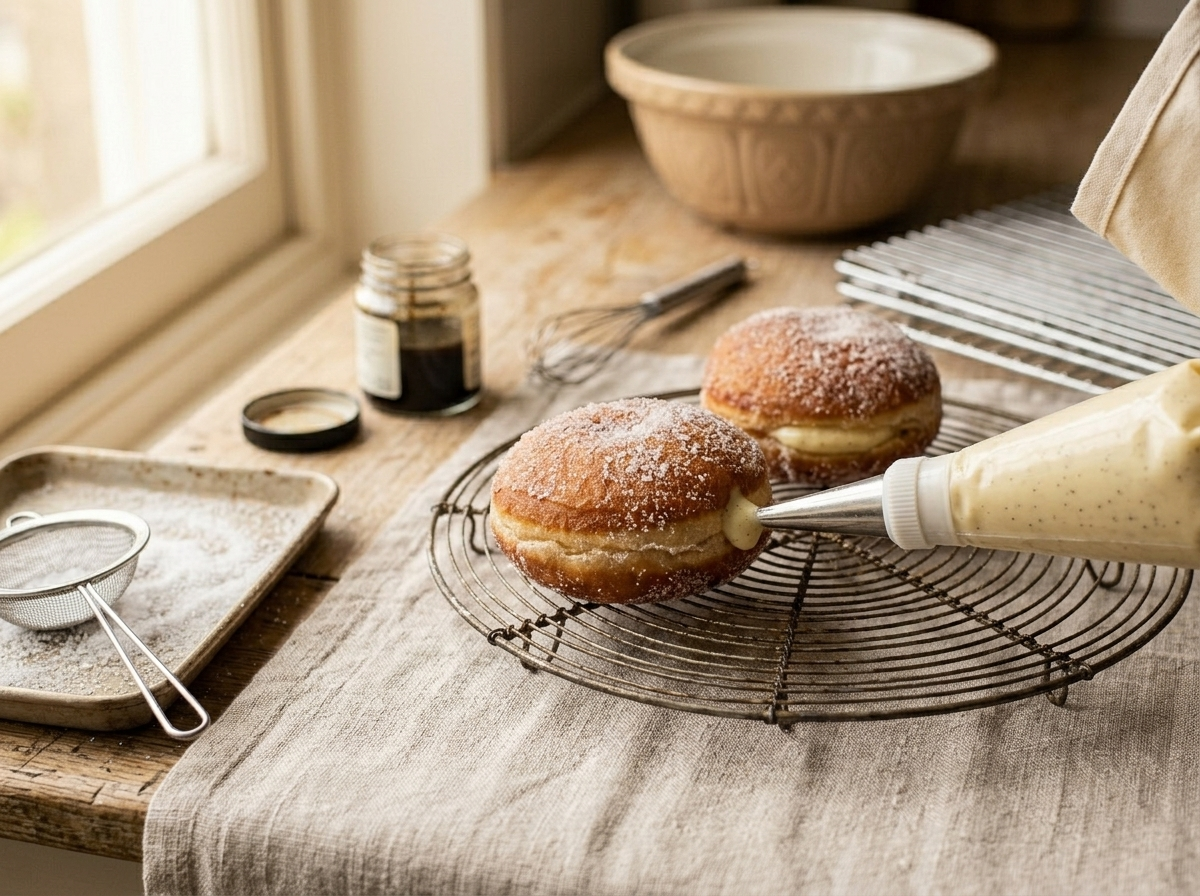
The vanilla custard is made on the stovetop, chilled until firm, then piped into each doughnut once fried. It stays smooth and cool against the warm dough.
Spelt dough is slightly more delicate than standard dough. It needs a lighter hand during kneading and a longer, cooler proof. Follow the timing and the results are consistent.
You can fry these the same day or proof the shaped doughnuts overnight in the fridge for a slow, cold rise.
Why You’ll Love This Recipe
- Spelt flour adds a nutty depth plain flour can’t match
- Custard filling stays smooth and pipeable after chilling
- Dough proofs overnight, so morning frying is easy
- Fries golden in under two minutes per side
Ingredient Notes
- White spelt flour: Use white spelt flour, not wholemeal, for a lighter dough. Wholemeal spelt makes the dough denser and harder to fry evenly.
- Whole milk (dough): Warm the milk to around 38 C / 100 F – it should feel just warm on your wrist. Too hot and it kills the yeast.
- Fast-action dried yeast: Check the expiry date before using. Stale yeast gives a flat dough that won’t recover after proofing.
- Unsalted butter (dough): Soften the butter before adding it to the dough. Cold butter tears the gluten structure of spelt, which is already more fragile than wheat.
- Whole milk (custard): Full-fat milk gives the custard body. Semi-skimmed works but the custard sets slightly softer and may weep when piped.
- Vanilla bean paste: Paste gives a stronger flavour and visible seeds. A good vanilla extract works fine at the same quantity.
- Egg yolks (custard): Use large egg yolks for a richer, more stable set. Whisk them with the sugar immediately to prevent surface graining.
- Vegetable oil (frying): Use a neutral oil with a high smoke point – sunflower or rapeseed work well. Avoid olive oil, which burns at frying temperature.
Spelt Vanilla Custard Doughnuts
Description
Spelt flour gives these doughnuts a slightly nutty, tender crumb that holds the vanilla custard filling without going soggy. The custard is set just firm enough to pipe cleanly, and the dough fries to a deep golden colour in under two minutes per side.
Ingredients
Doughnut Dough
Vanilla Custard Filling
For Frying and Finishing
Instructions
Make the Vanilla Custard
- Pour the milk into a medium saucepan and add the vanilla bean paste. Heat over medium heat until the milk just begins to steam - do not boil. Remove from heat.
- In a medium bowl, whisk the egg yolks and caster sugar together until pale, about 1 minute. Add the cornflour and whisk until smooth.
- Pour roughly one-third of the warm milk into the egg mixture in a slow, steady stream, whisking constantly to temper the eggs.
- Pour the tempered mixture back into the saucepan with the remaining milk. Cook over medium-low heat, whisking continuously, until the custard thickens and large bubbles break the surface, about 4 to 5 minutes.
- Remove from heat and stir in the butter until melted and smooth. Pour into a clean bowl, press cling film directly onto the surface, and refrigerate for at least 3 hours until fully set and cold.
Make the Dough
- Combine the white spelt flour, yeast, caster sugar, and salt in the bowl of a stand mixer fitted with a dough hook. Stir briefly to distribute the yeast and salt on opposite sides of the bowl.
- Add the warm milk and beaten eggs. Mix on low speed for 2 minutes until a shaggy dough forms.
- Increase to medium speed and add the softened butter one or two pieces at a time, waiting for each addition to incorporate before adding the next. Mix for a total of 5 to 6 minutes until the dough is smooth, slightly tacky, and pulls cleanly from the sides of the bowl.
- Shape the dough into a ball and place in a lightly oiled bowl. Cover with cling film and leave in a warm spot for 1 hour to 1 hour 30 minutes, until doubled in size.
Shape and Proof
- Tip the dough onto a lightly floured surface. Press gently to deflate. Roll out to 1.5 cm thickness.
- Cut out rounds using a 7 cm round cutter. Re-roll scraps once to cut more rounds. You should get 10 doughnuts.
- Place the rounds on two baking trays lined with non-stick paper, spacing them at least 5 cm apart. Cover loosely with oiled cling film and proof for 45 to 60 minutes until visibly puffed and the dough springs back slowly when poked.
Fry the Doughnuts
- Pour the oil into a deep heavy-based saucepan. Heat over medium heat to 170 C to 175 C, measured with an instant-read thermometer.
- Fry the doughnuts in batches of 2 to 3, lifting each from the paper using a thin spatula to avoid deflating. Fry for 90 seconds per side until deep golden brown.
- Remove with a slotted spoon and drain on a wire rack set over a tray. Allow to cool for 5 minutes before filling. Check and adjust the oil temperature between each batch.
Fill and Finish
- Spoon the chilled custard into a piping bag fitted with a long filling nozzle. Use a skewer to poke a hole into the side of each doughnut, angling it toward the centre.
- Insert the nozzle into the hole and pipe custard slowly until you feel gentle resistance from the dough expanding, about 30 to 35 g per doughnut.
- Roll each filled doughnut in caster sugar while still slightly warm, coating evenly. Serve within 20 minutes.
Nutrition Facts
Servings 10
- Amount Per Serving
- Calories 380kcal
- % Daily Value *
- Total Fat 18g28%
- Saturated Fat 7g35%
- Cholesterol 145mg49%
- Sodium 220mg10%
- Potassium 190mg6%
- Total Carbohydrate 52g18%
- Dietary Fiber 3g12%
- Sugars 22g
- Protein 9g18%
- Vitamin A 420 IU
- Calcium 110 mg
- Iron 2 mg
- Vitamin D 28 IU
- Vitamin E 2 mg
- Vitamin K 3 mcg
- Thiamin 0.2 mg
- Riboflavin 0.3 mg
- Niacin 3 mg
- Vitamin B6 0.1 mg
- Folate 35 mcg
- Vitamin B12 0.5 mcg
- Phosphorus 160 mg
- Magnesium 28 mg
- Zinc 1.2 mg
* Percent Daily Values are based on a 2,000 calorie diet. Your daily value may be higher or lower depending on your calorie needs.
Note
Additional Notes
- Do not over-knead spelt dough - 5 to 6 minutes by hand is enough.
- Chill custard for at least 3 hours before piping.
- Keep frying oil at 170 C to 175 C throughout - use a thermometer.
- Proof shaped doughnuts in a warm spot for 45 to 60 minutes until visibly puffed.
- Fill doughnuts on the day of serving - custard softens the shell overnight.