
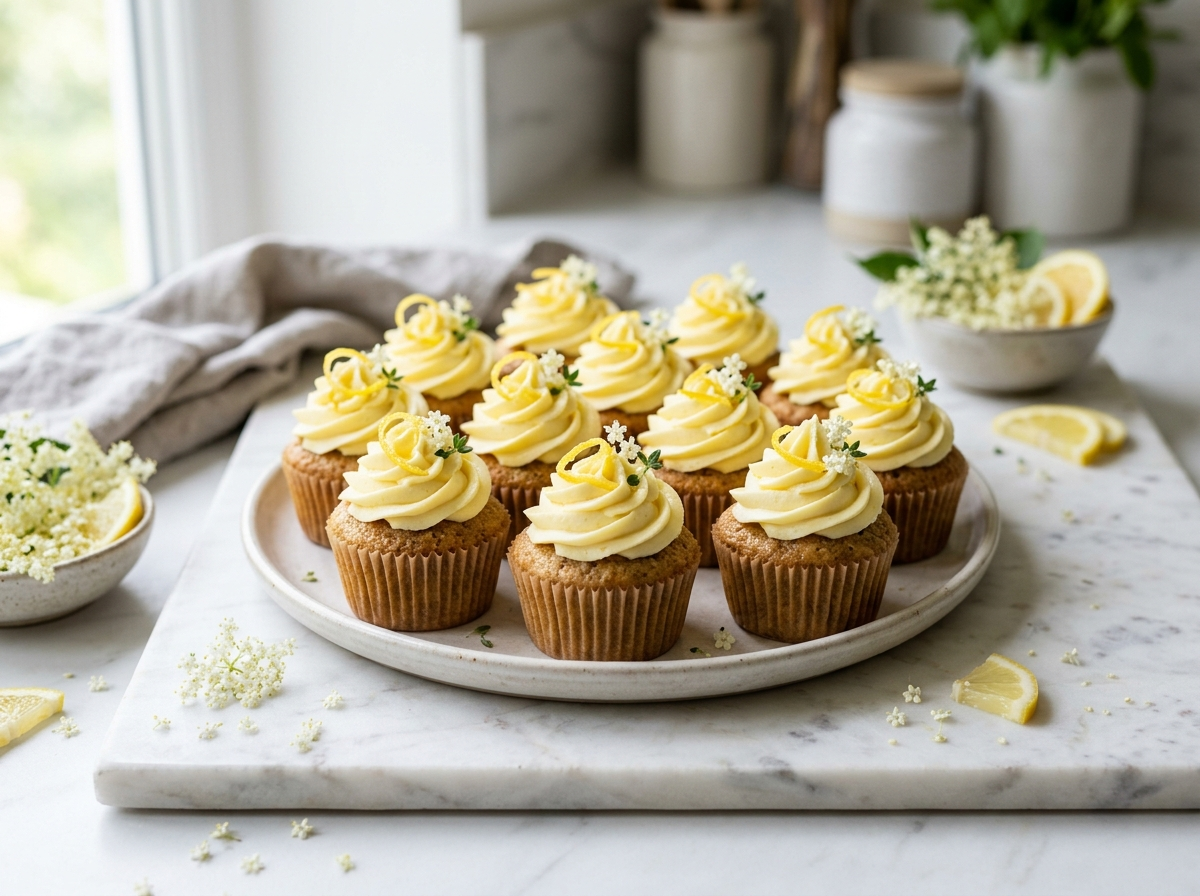
These cupcakes use white spelt flour in place of plain flour. The result is a slightly nuttier crumb that stays moist for longer than a standard sponge.
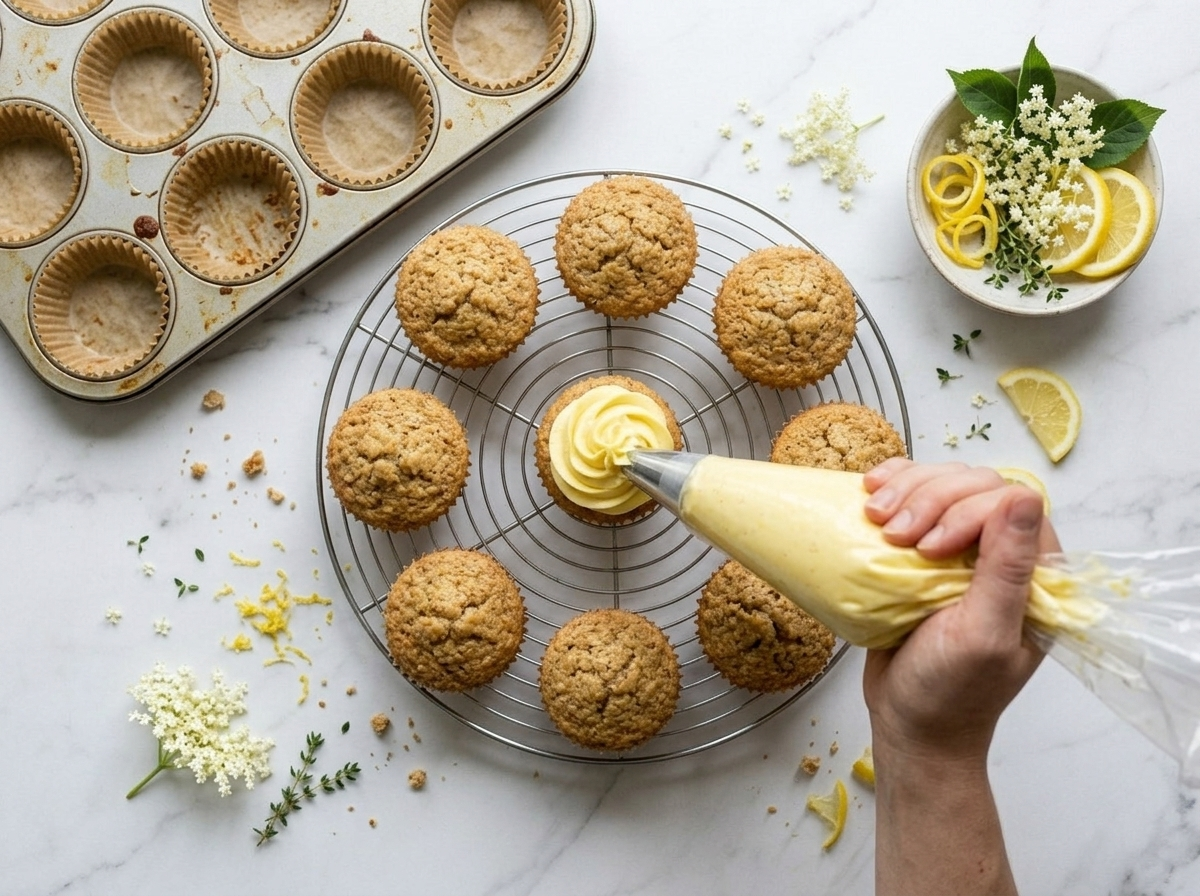
The lemon does the heavy lifting in the batter – zest in the sponge, juice in the glaze. Elderflower comes through in the buttercream, where it softens without overpowering.
You can bake the sponges a day ahead and frost them on the day. They hold their shape well at room temperature for a few hours, which makes them practical for afternoon tea or a casual gathering.
No special equipment needed beyond a hand mixer and a standard 12-hole muffin tin.
Why You’ll Love This Recipe
- Spelt sponge stays moist longer than plain flour.
- Elderflower buttercream is floral without being sweet.
- Bake the sponges ahead, frost on the day.
- No specialist ingredients – cordial works perfectly here.
Ingredient Notes
- White spelt flour: White spelt gives a lighter crumb than wholegrain spelt. You can swap half for wholegrain spelt if you prefer a nuttier texture, but the cupcakes will be slightly denser.
- Elderflower cordial: I use Belvoir or Bottlegreen. Avoid diluting it before adding – you want the concentrated floral flavour. Elderflower liqueur (St Germain) also works if you’re making these for adults.
- Unsalted butter: Use soft, room-temperature butter for both the sponge and the buttercream. Cold butter won’t cream properly and gives a lumpy batter.
- Lemon zest: Two unwaxed lemons give enough zest for the batter and candied topping. If you only have waxed lemons, scrub them in hot water first.
- Lemon curd: Jarred lemon curd works fine as a filling. You can also make your own – use about 1 tsp per cupcake. Leave it out if you prefer a simpler build.
- Full-fat cream cheese (optional): Adding 50 g of cream cheese to the buttercream cuts the sweetness and gives it more body. Skip it for a more traditional frosting.
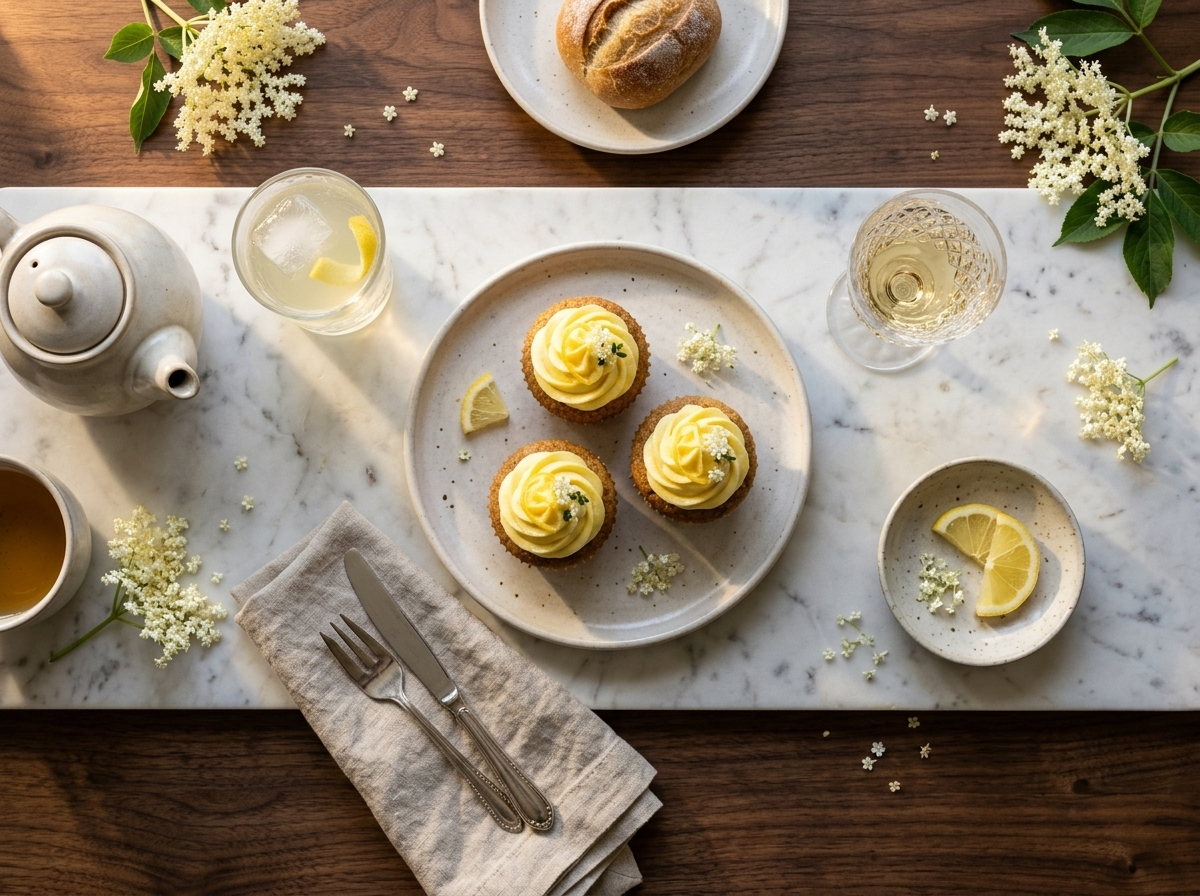
Spelt Lemon Elderflower Cupcakes
Description
Wholegrain spelt keeps the sponge tender without making it dense, while elderflower cordial in the buttercream adds a clean floral note that pairs naturally with the sharp lemon.
Ingredients
Cupcake Sponge
Lemon Curd Filling
Elderflower Buttercream
Candied Lemon Zest (optional topping)
Instructions
Candied Lemon Zest
- Combine the sugar and water in a small saucepan over medium heat. Stir until the sugar dissolves, then bring to a gentle simmer.
- Add the lemon zest strips and simmer for 8 to 10 minutes until translucent and slightly sticky.
- Lift the zest onto a sheet of baking paper with a fork and leave to dry for at least 30 minutes before using. Set the syrup aside.
Cupcake Sponge
- Heat the oven to 175 C / 350 F. Line a 12-hole muffin tin with paper cupcake cases.
- Whisk together the spelt flour, baking powder, and salt in a bowl. Set aside.
- Beat the softened butter and caster sugar together with an electric hand mixer on medium-high for 3 to 4 minutes until pale and fluffy.
- Add the eggs one at a time, beating well after each addition. Scrape down the sides of the bowl as needed.
- Mix in the lemon zest and lemon juice until just combined.
- Add half the flour mixture and fold in gently with a spatula. Pour in the milk, fold again, then add the remaining flour and fold until just combined with no dry streaks.
- Divide the batter evenly between the 12 cases, filling each two-thirds full. Bake for 18 to 20 minutes until golden and a skewer inserted in the centre comes out clean.
- Remove from the oven and cool in the tin for 5 minutes, then transfer to a wire rack to cool completely.
Elderflower Buttercream
- Beat the softened butter with an electric hand mixer on medium for 2 minutes until smooth and slightly lighter in colour.
- Add the sifted icing sugar in two batches, beating on low first to avoid a cloud of sugar, then on medium-high for 2 minutes.
- Add the elderflower cordial one tablespoon at a time, tasting as you go. Add the lemon juice and a pinch of salt, then beat for another minute until smooth and spreadable.
- If the buttercream is too stiff, add 1 teaspoon of milk. If too soft, refrigerate for 10 minutes before piping.
Assemble
- Use a small sharp knife or apple corer to cut a shallow hole (about 2 cm deep) from the centre of each cooled cupcake. Keep the cut-out piece.
- Spoon or pipe roughly 1 teaspoon of lemon curd into each hole, then press the cut-out back on top to seal it.
- Transfer the buttercream to a piping bag fitted with a 1M star tip. Pipe a swirl onto each cupcake, starting from the outer edge and spiralling inward.
- Top each cupcake with a few strands of candied lemon zest or a small curl of fresh lemon zest. Drizzle a small drop of the reserved lemon syrup over the top if you like a glossy finish.
Nutrition Facts
Servings 12
- Amount Per Serving
- Calories 340kcal
- % Daily Value *
- Total Fat 18g28%
- Saturated Fat 11g56%
- Cholesterol 85mg29%
- Sodium 95mg4%
- Potassium 85mg3%
- Total Carbohydrate 42g15%
- Dietary Fiber 2g8%
- Sugars 30g
- Protein 4g8%
- Vitamin A 520 IU
- Vitamin C 4 mg
- Calcium 45 mg
- Iron 1 mg
- Vitamin D 18 IU
- Vitamin E 1 mg
- Vitamin K 2 mcg
- Thiamin 0.1 mg
- Riboflavin 0.1 mg
- Niacin 1.2 mg
- Vitamin B6 0.05 mg
- Folate 18 mcg
- Vitamin B12 0.2 mcg
- Phosphorus 90 mg
- Magnesium 20 mg
- Zinc 0.6 mg
* Percent Daily Values are based on a 2,000 calorie diet. Your daily value may be higher or lower depending on your calorie needs.
Note
Additional Notes
- Use room-temperature eggs to prevent the batter from curdling when added to creamed butter.
- Do not overmix the batter once the flour is added - stir until just combined.
- Fill each cupcake case two-thirds full to leave room for an even rise.
- Chill the filled piping bag for 10 minutes if the buttercream feels too soft to pipe cleanly.
- Candied lemon zest can be made up to 3 days ahead and stored in a dry container.