
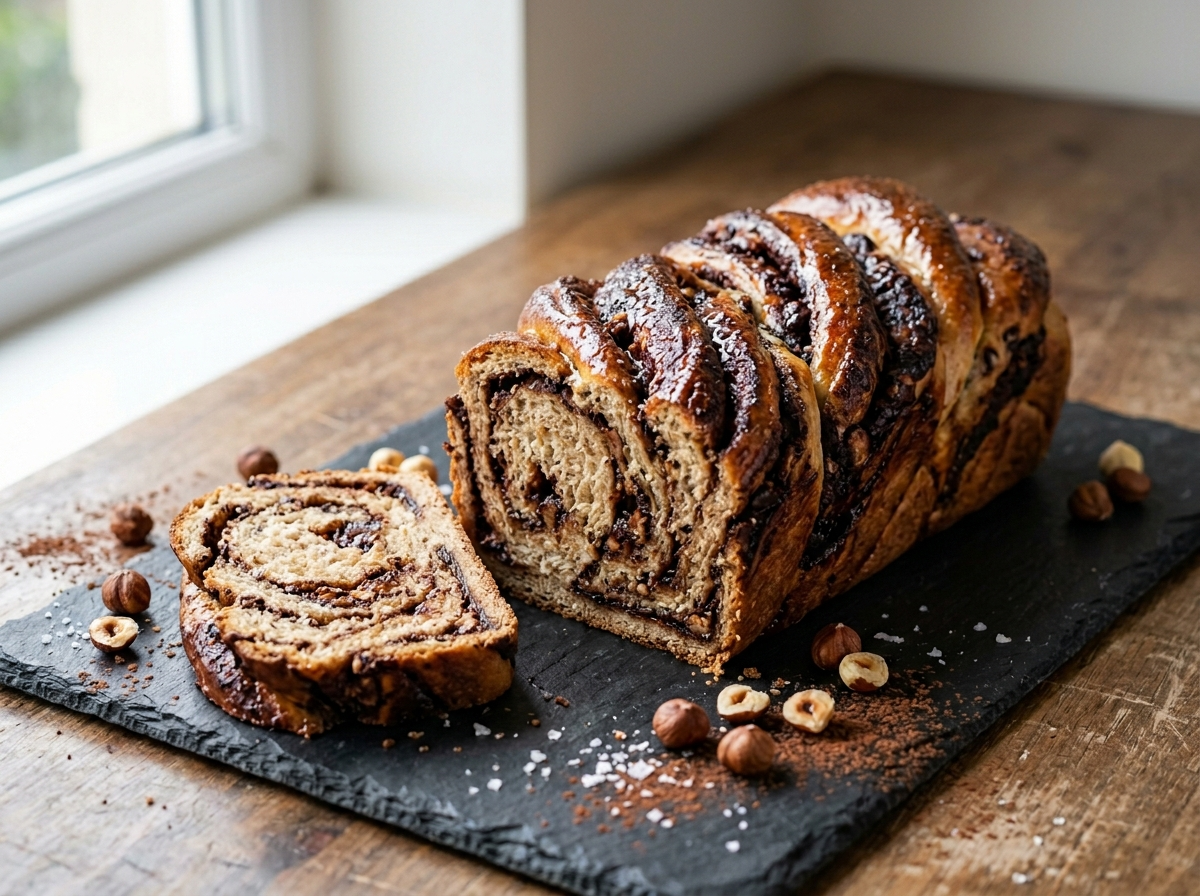
Babka looks impressive, but the process is straightforward once you understand the dough. Spelt flour keeps things lighter than plain white flour, with a mild, nutty quality that pairs well with dark chocolate.
The filling is a simple mix of cocoa, ground hazelnuts, butter, and sugar. You spread it over the rolled dough, twist the loaf, and the oven does the rest.
This recipe works well for weekend baking or as a make-ahead loaf for a gathering. The dough can prove overnight in the fridge, which actually improves the flavour and makes the morning assembly much easier.
A sugar syrup brushed on straight from the oven gives the babka its characteristic shine and keeps the crust soft rather than dry.
Why You’ll Love This Recipe
- Spelt dough stays tender and moist after baking
- Overnight prove option fits around a busy schedule
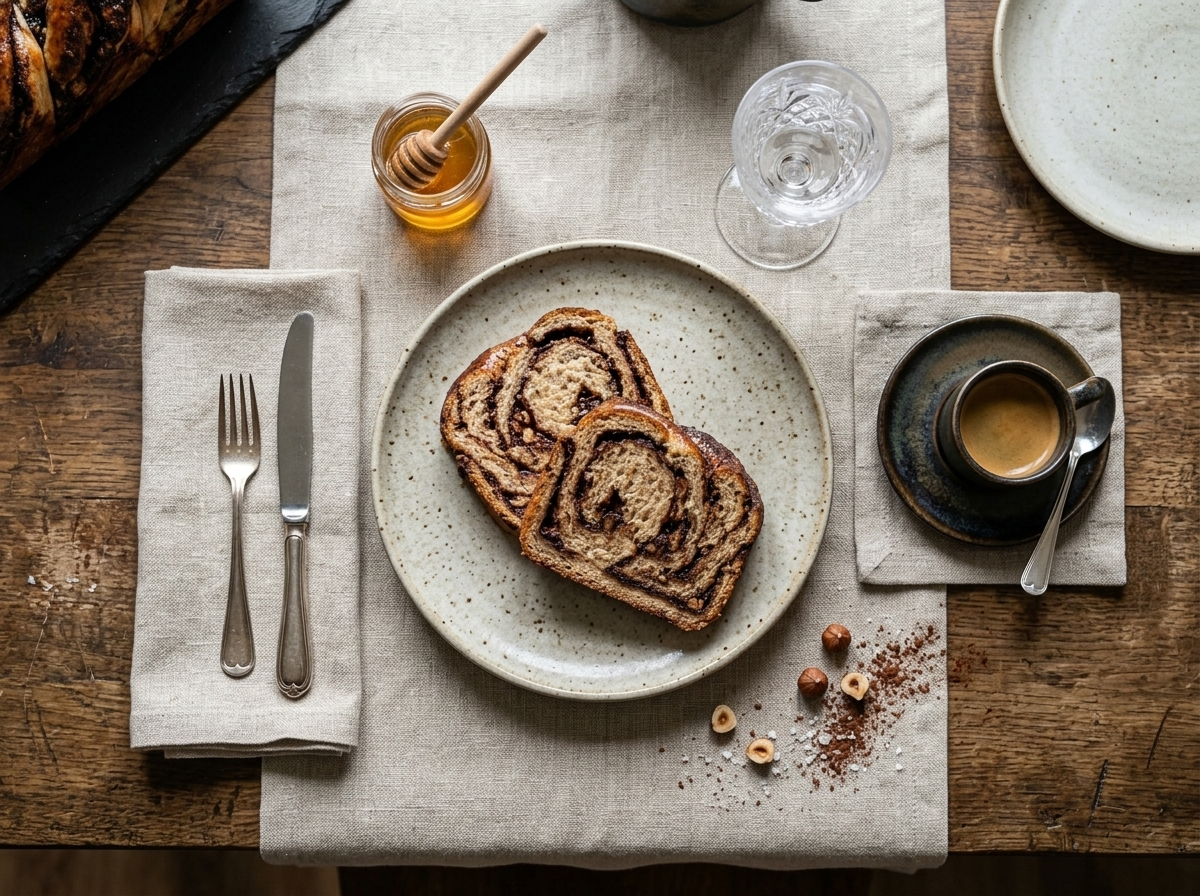
- Distinct chocolate hazelnut layers visible in every slice
- Freezes well and reheats without losing texture
Ingredient Notes
- White spelt flour: White spelt flour gives a lighter crumb than wholegrain spelt. You can use wholegrain spelt, but the loaf will be denser and will need an extra splash of milk in the dough.
- Active dried yeast: Active dried yeast needs to be dissolved in warm milk before mixing. If using instant yeast, reduce the amount by 25 percent and mix it directly into the dry ingredients.
- Whole milk: Whole milk produces the softest dough. Oat milk works as a dairy-free substitute and gives a neutral flavour that doesn’t compete with the chocolate.
- Unsalted butter (dough): Softened butter incorporates more evenly. If your butter is cold, cube it and let it sit at room temperature for 20 minutes before mixing.
- Cocoa powder: Dutch-process cocoa gives a darker, less bitter filling. Natural cocoa works too but produces a slightly sharper chocolate flavour.
- Blanched hazelnuts: Toast and grind the hazelnuts yourself for the best flavour. Pre-ground hazelnut meal is a quick substitute but loses some of the roasted depth.
- Dark chocolate: Use chocolate with 60 to 70 percent cocoa solids for a filling that sets firmly without being too bitter. Milk chocolate makes the filling sweeter and softer.
Spelt Chocolate Hazelnut Babka
Description
Spelt flour gives this babka a slightly nutty, tender crumb that stays moist longer than standard wheat loaves. The chocolate hazelnut filling bakes into distinct, glossy layers that hold their shape when sliced.
Ingredients
Spelt Dough
Chocolate Hazelnut Filling
Sugar Syrup
Instructions
Make the Dough
- Warm the milk to 38 C / 100 F. Stir in the yeast and 1 tsp of the caster sugar. Leave for 10 minutes until frothy.
- In a stand mixer bowl, combine the spelt flour, remaining caster sugar, and salt. Make a well in the centre.
- Pour the yeast mixture and eggs into the well. Mix on low speed with the dough hook for 3 minutes until a shaggy dough forms.
- Add the softened butter a few cubes at a time, mixing on medium speed. Continue for 8 to 10 minutes until the dough is smooth and slightly tacky but not sticky.
- Shape the dough into a ball. Place in a lightly oiled bowl, cover with a clean towel, and prove at room temperature for 1 to 1.5 hours until doubled in size. Alternatively, refrigerate overnight for up to 16 hours.
Make the Filling
- Toast the blanched hazelnuts in a dry frying pan over medium heat for 6 to 8 minutes until golden and fragrant. Cool completely, then blitz in a food processor to a coarse, sandy texture.
- Melt the chopped dark chocolate in a heatproof bowl set over barely simmering water, stirring until smooth. Remove from heat and cool for 5 minutes.
- Beat the softened butter and icing sugar together until pale. Stir in the cocoa powder, melted chocolate, ground hazelnuts, and salt until a thick, spreadable paste forms.
Shape the Babka
- Lightly flour a work surface. Roll the proved dough into a rectangle roughly 40 x 30 cm and 3 mm thick.
- Spread the chocolate hazelnut filling evenly over the dough, leaving a 1 cm border along one long edge.
- Roll the dough tightly from the opposite long edge into a firm log. Chill the log for 20 minutes to firm up.
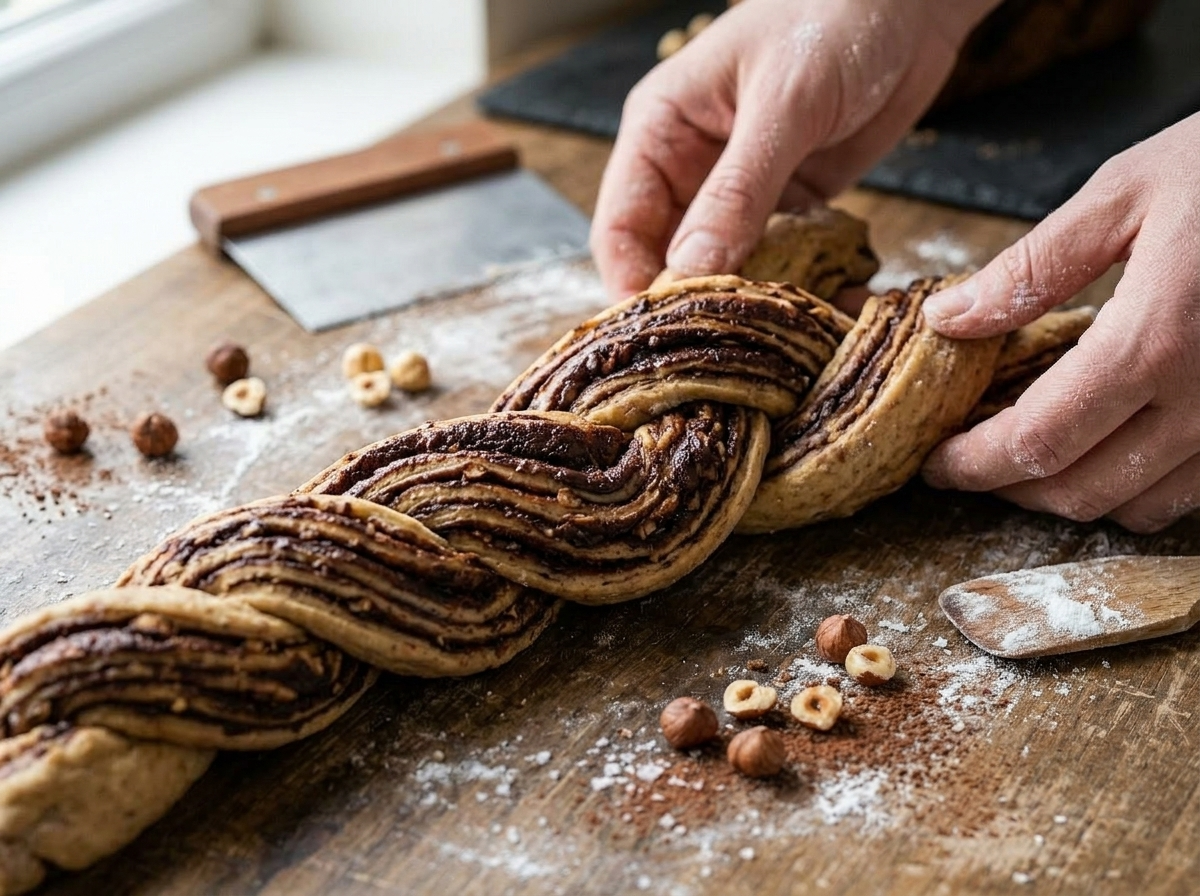
- Using a sharp knife, slice the log in half lengthways to expose the layers. Place the two halves cut-side up and twist them around each other twice, keeping the cut sides facing outward.
- Grease a 9 x 4 inch loaf tin. Transfer the twisted loaf into the tin, tucking the ends under neatly. Cover and prove for 45 to 60 minutes until the dough rises to just above the rim of the tin.
Bake and Finish
- Heat the oven to 180 C / 355 F. Bake the babka for 35 to 40 minutes until deep golden brown. A probe thermometer inserted into the centre should read 93 C / 200 F.
- While the babka bakes, combine the sugar and water in a small saucepan over medium heat. Stir until the sugar dissolves, then simmer for 2 minutes. Remove from heat.
- As soon as the babka comes out of the oven, brush the sugar syrup generously over the entire surface. Leave the loaf in the tin for 15 minutes, then turn out onto a wire rack to cool.
Nutrition Facts
Servings 10
- Amount Per Serving
- Calories 385kcal
- % Daily Value *
- Total Fat 18g28%
- Saturated Fat 8g40%
- Cholesterol 55mg19%
- Sodium 135mg6%
- Potassium 280mg8%
- Total Carbohydrate 48g16%
- Dietary Fiber 5g20%
- Sugars 22g
- Protein 9g18%
- Vitamin A 260 IU
- Calcium 45 mg
- Iron 3 mg
- Vitamin D 18 IU
- Vitamin E 2.8 mg
- Vitamin K 4 mcg
- Thiamin 0.3 mg
- Riboflavin 0.2 mg
- Niacin 3 mg
- Vitamin B6 0.2 mg
- Folate 35 mcg
- Vitamin B12 0.3 mcg
- Phosphorus 195 mg
- Magnesium 48 mg
- Zinc 1.4 mg
* Percent Daily Values are based on a 2,000 calorie diet. Your daily value may be higher or lower depending on your calorie needs.
Note
Additional Notes
- Prove the dough in a warm spot (around 24 C) for the most consistent rise.
- Do not over-flour the surface when rolling - excess flour creates dry, uneven layers.
- Chill the shaped loaf for 15 minutes before the second prove if the kitchen is warm.
- Apply sugar syrup immediately out of the oven while the loaf is still hot.
- Rest the baked babka in the tin for 15 minutes before turning out to prevent tearing.